Epitalon is a peptide four amino acids long, made in Leningrad in the 1980s. It copies the amino-acid makeup of an extract of cow pineal gland.
What matters first
Why people look it up
It is sold for longevity — longer telomeres, better sleep, slower aging.
What the evidence shows
The lifespan results people quote were produced by the gland extract, not by this peptide. One monkey experiment ran both side by side and used five hundred times more of the extract. Two human studies of the peptide itself exist. They measured eyesight and a urine marker, and both came out of the institute that made it.
Dose status
Epitalon is not FDA-approved, so no dosing label exists for it. The sections below explain what researchers tested and what remains unknown.
Epitalon is a four-amino-acid sequence, made in Leningrad in the 1980s from the amino acids of Epithalamin, a bovine pineal gland extract. Two human studies of the peptide state a dose: one behind the eye in 162 patients, one under the tongue in 75 women. Both came from the institute that made it, and neither used an injection under the skin. Its reputation, though, rests on telomerase activity and longer life in animals. Those lifespan results belong to the extract, not to this peptide.
Epitalon research and regulatory details: evidence quality, approval status, doses, handling, and presentation.
Topic
Value
Strongest source
limited human data
FDA approval
Not FDA-approved
Studied dosing
0.5 mg once a day for twenty days (75 women, with a placebo group and an untreated group; the endpoints were a melatonin marker in urine and three clock genes in blood cells)— from clinical trials
Studied dosing
5 mcg per eye on ten days in a row (162 patients aged 18 to 72 with retinitis pigmentosa; the comparison group got the usual treatments of 2002, and no treated patient reported a side effect)— from clinical trials
Typical vials
10 mg
Every row links back to a source listed below. These facts are for reference, not a personal recommendation.
What the evidence for Epitalon is
People have received this compound in a documented setting, or it has approval outside the United States. The available human evidence is still too limited to show a clear dose-and-result pattern for US use.
limited human data
What it establishes
It shows that people have received it and that some human information exists.
What it does not establish
It does not prove that the same dose is appropriate in the United States or that uncommon and long-term risks are known.
Check the country, study size and reason it was used. Do not treat limited human data as an FDA-approved schedule.
Evidence snapshot and shareable image
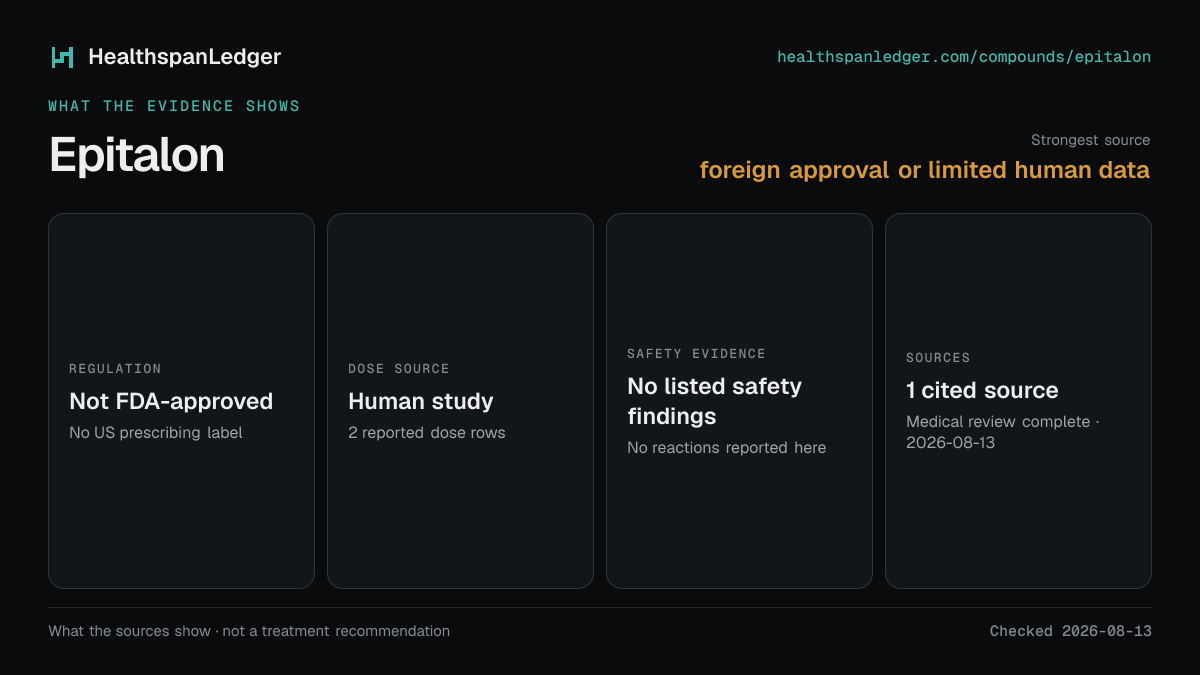
Epitalon at a glance: foreign approval or limited human data, dosing basis, regulatory status, safety coverage, and cited-source count. These details summarize the available sources; they are not treatment recommendations.
Evidence snapshot
Foreign approval or limited human data
The fastest way to see what kind of evidence this page is built on.
Regulation
Not FDA-approvedNo US prescribing label
Dose source
Human study2 reported dose rows
Safety evidence
No safety findings listedAn empty list does not establish safety
Epitalon at a glance: foreign approval or limited human data, dosing basis, regulatory status, safety coverage, and cited-source count. These details summarize the available sources; they are not treatment recommendations.
Where Epitalon is in clinical trials
No trial of this compound is registered on ClinicalTrials.gov.
That is worth sitting with. Nobody has registered a study to find out whether Epitalon works in people, so no result is coming and no date is worth waiting for. Sellers are not waiting for that work either.
A registered study means a sponsor filed a plan and started enrolling. It is not evidence the drug works, and most drugs tested in people never reach a pharmacy. Sponsors write and update these sources themselves; the National Library of Medicine publishes them without checking them.
The research here is mostly in Russian, and it comes from one group.
That is a provenance problem, not a language one. Findings no one else has repeated carry the weight of one lab’s claim. The human lifespan result people quote here is not this peptide’s.
It belongs to Epithalamin, the bovine pineal extract that the same two institutes tested. Epitalon holds no approval, no investigational application and no pharmacopeial entry in any Western jurisdiction. Telomerase activation is also not plainly desirable.
Neither human study used an injection under the skin. One went behind the eye. One went under the tongue. This site models the vial as an injection under the skin, so no published quantity matches how the product here is used
Both quantities on this page were read out of a 2025 review. Neither original paper prints them. The eye report says only that most patients improved. The sleep-rhythm one is in Russian and gives no dose and no headcount
The review and the original also disagree on the size of the effect. It is 1.6 times the placebo group in the review and 1.7 times in the paper it cites. That gap is small. It is also the kind of drift that shows the chain has more than one link
The human study people cite for this peptide tested something else. The 266-subject and 12-year mortality reports used Epithalamin, a bovine pineal gland extract. They did not use the synthetic four-residue peptide sold under this name
One monkey experiment gave both substances side by side. It used 5 mg of the extract per animal a day, against 10 micrograms of this peptide. That is a five-hundred-fold gap, inside one paper, between two things people quote as one
Several of the human papers are indexed as randomized controlled trials, so calling this literature unrandomized would be wrong. The true objection is narrower and worse. The main reports do not state their doses. None is registered on ClinicalTrials.gov. No Western group has repeated any of it
Most of what has been measured is not an outcome in a person. It is melatonin output in cell culture, interleukin-2 messenger RNA, mouse thymus cells, and the activity of enzymes such as telomerase. The two human studies measured eyesight and a urine marker, not lifespan
Essentially the whole literature comes from two institutes, on both the extract and the peptide. They are the St Petersburg Institute of Bioregulation and Gerontology and the Institute of Gerontology in Kiev. The same senior author runs through all of it, and no independent group has reproduced it
A ClinicalTrials.gov search on 12 August 2026 returned no registered study under either spelling, epitalon or epithalon. So there is no trial in progress to wait for
FDA named the substance, spelled Epithalon, in a warning letter dated 20 January 2026 to a compounder. Obtainable is not the same as permitted
FDA’s Pharmacy Compounding Advisory Committee reviewed it on 24 July 2026 for insomnia. The agency’s own briefing document proposed that it not be added to the 503A bulks list. No outcome document has appeared since
Telomerase activation is a mechanism tumors depend on, so it is not a plainly good effect
Vial strengths sold under this name differ between sellers, so a quantity quoted without its vial size is unusable
Questions about Epitalon
Is Epitalon FDA-approved?
No. There is no prescribing label for it, so no approved dose exists — the regulatory status section above has the detail.
How is Epitalon taken?
Trials study it both under the tongue and by injection behind the eye. The table above keeps each route and schedule separate.
How does Epitalon differ from the other compounds in this class?
Epitalon has been studied in people, but it works through a different system from GLP-1 and amylin drugs. Its doses and results are not directly comparable with theirs.
What is not known about Epitalon?
It does not prove that the same dose is appropriate in the United States or that uncommon and long-term risks are known.
1primary source, each with the day we read it — open the documents used on this page