Page last checked
Research compound · not FDA-approved
Zenagamtide
Zenagamtide, once called Amycretin, is an experimental weight-loss drug being tested as an injection and a pill. It acts on GLP-1 and amylin signals.
What matters first
- Why people look it up
- Sellers offer unapproved versions to people seeking weight loss, often under the older Amycretin name.
- What the evidence shows
- Early trials reported average weight loss with injected and oral forms. Phase 3 trials are registered, but no phase 3 result is available.
- Dose status
- Zenagamtide is not FDA-approved, so no dosing label exists for it. The sections below explain what researchers tested and what remains unknown.
What is known about Zenagamtide
Zenagamtide, once called Amycretin, is an experimental shot and pill that acts on GLP-1 and amylin signals. An early shot study tested four doses for 20, 28 or 36 weeks. The 60 mg group lost an average of 24.3% at week 36, versus 1.1% with placebo. A later company update reported up to 14.6% in people with diabetes. No phase 3 result exists yet.
| Topic | Value |
|---|---|
| Strongest source | Human trial |
| FDA approval | Not FDA-approved |
| Studied dosing | 1–25 mg one dose in phase 1 (1, 3, 6, 12, 18 or 25 mg) — from clinical trials |
| Studied dosing | 3–12 mg daily for 10 days in phase 1 (3, 6 or 12 mg) — from clinical trials |
| Studied dosing | 50–100 mg daily for 12 weeks after trial-set titration to a 50 or 100 mg target — from clinical trials |
| Studied dosing | 1.25 mg once weekly for 20 weeks in phase 1b/2a — from clinical trials |
| Studied dosing | 5 mg once weekly for 28 weeks in phase 1b/2a — from clinical trials |
| Studied dosing | 20–60 mg once weekly for 36 weeks in phase 1b/2a (20 or 60 mg targets) — from clinical trials |
| Studied dosing | 0.4–40 mg once weekly for 36 weeks in a company-announced phase 2b diabetes study — from clinical trials |
| Presentation | Zenagamtide has no approved vial or reconstitution instructions; its trials study prepared oral and subcutaneous formulations. |
Every row links back to a source listed below. These facts are for reference, not a personal recommendation.
How Zenagamtide works
Zenagamtide acts at GLP-1 + amylin. Here is what that means.
This design puts two meal-ending signals into one peptide. GLP-1 is released by the gut after eating. Amylin is released by the pancreas alongside insulin. Both can reduce how much someone eats, but they reach that outcome through different receptor systems.
| Receptor | Zenagamtide | What it does |
|---|---|---|
| GLP-1 | pancreas, gut and brainSupports insulin release while blood sugar is rising, slows stomach emptying and acts on brain circuits involved in appetite. The same stomach effect can also produce nausea and early fullness. | |
| GIP | — | |
| Glucagon | — | |
| Amylin | area postrema and hindbrainAdds a separate fullness signal from the brainstem and also slows how quickly food leaves the stomach. It is not a second GLP-1 signal, even when the visible effects overlap. |
The same four receptor groups are shown for every drug, so the differences are easy to compare. Targets come from the drug class. Any result specific to Zenagamtide comes from the cited sources.
The pairing reaches fullness through two pathways. One milligram on either pathway does not mean the same thing. Trials still need to show whether that balance improves long-term results or how well people handle the drug. Early weight-loss results cannot answer that on their own.
What the evidence for Zenagamtide is
These numbers come from a study in people that was published in a peer-reviewed journal. The drug or dose may still be experimental and may not have FDA approval.
- What it establishes
- What it does not establish
Read each result with the study length, dose and number of participants. Results from separate trials are not a direct comparison because the people and study designs differ.
Evidence snapshot and shareable image
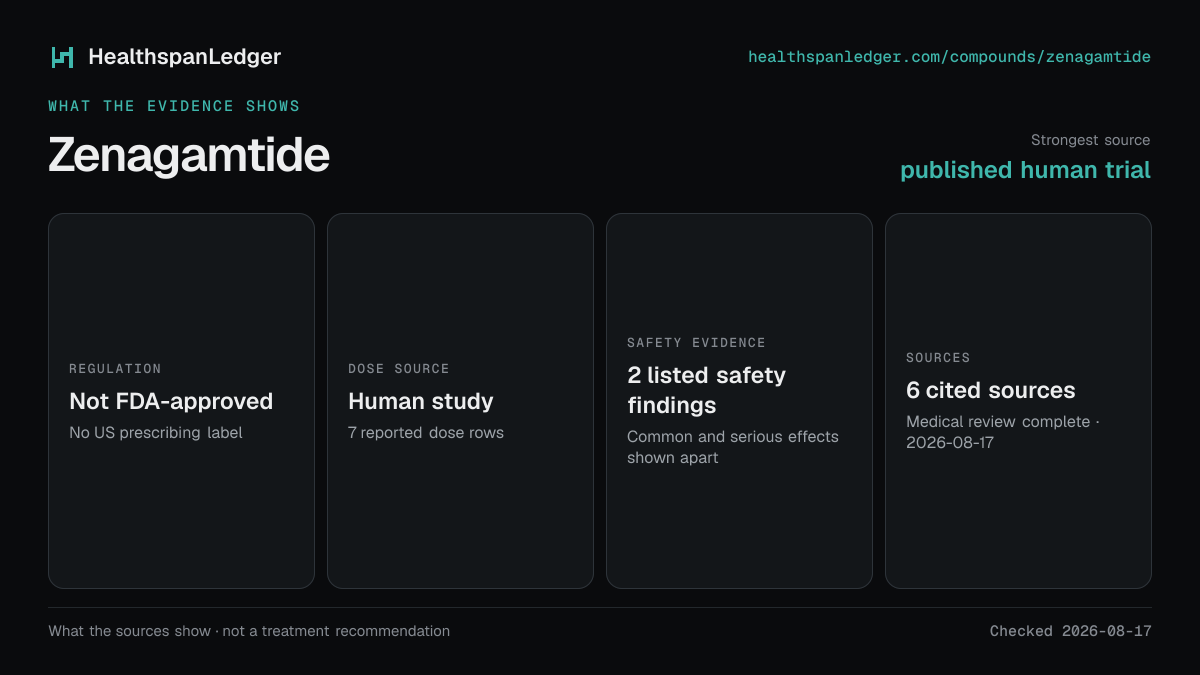
Evidence snapshot
Published human trial
- Regulation
- Dose source
- Safety evidence
- Sources
Where Zenagamtide is in clinical trials
5 registered studies; the program has reached phase 3, and one is still enrolling.
The soonest a running study expects to finish measuring people is June 2028. That is when the sponsor expects to finish collecting the main measurement. It is not a results date, and not a date anything goes on sale.
- Phase 3Recruiting
- Phase 3Not yet recruiting
- Phase 3Not yet recruiting
ClinicalTrials.gov · retrieved 2026-09-27
Regulatory status
Zenagamtide is not FDA-approved and has no approved dose.
The pill and shot use different study schedules. A listed trial shows what researchers plan to test; it does not prove that the drug works.
Full regulatory tracker →Where to go next on Zenagamtide
The related pages keep each topic with its evidence.
Zenagamtide side effects, as the sources describe them
Vial, water and dose for any peptide, with zenagamtide as one example
Who else is sold for weight loss besides zenagamtide
What the tirzepatide page carries, separate from zenagamtide
What the brenipatide page carries, separate from zenagamtide
What the enicepatide page carries, separate from zenagamtide
What the MariTide page carries, separate from zenagamtide
The source-checked eloralintide entry, beyond the zenagamtide one
What the petrelintide page carries, separate from zenagamtide
VK2735 in the full list, alongside zenagamtide
Safety notes
Questions about Zenagamtide
Is Zenagamtide FDA-approved?
How is Zenagamtide taken?
How does Zenagamtide differ from the other compounds in this class?
What is not known about Zenagamtide?
- Knop FK et al. Oral amycretin in adults with overweight or obesity: phase 1 trial (NCT05369390, PMID 40550229)retrieved 2026-08-17Human trial
- Jastreboff AM et al. Subcutaneous amycretin in adults with overweight or obesity: phase 1b/2a trial (NCT06064006, PMID 40550231)retrieved 2026-08-17Human trial
- Novo Nordisk — 36-week phase 2b zenagamtide results in type 2 diabetesretrieved 2026-08-17Phase 2b results announced by the company
- NCT07668414 — AMAZE 7 phase 3 zenagamtide versus semaglutideretrieved 2026-08-17Human trial
- NCT07668401 — AMAZE 13 phase 3 subcutaneous zenagamtide versus placeboretrieved 2026-08-17Human trial
- NCT07720271 — AMAZE 9 phase 3 oral zenagamtide versus placeboretrieved 2026-08-17Human trial