Pemvidutide, once called ALT-801, is an experimental weekly injection. Researchers are testing it for weight loss, liver disease and problems linked to alcohol.
What matters first
Why people look it up
Sellers offer unapproved pemvidutide to people seeking weight loss.
What the evidence shows
Weight-loss and liver trials have reported results, and alcohol studies are still developing. A global phase 3 liver program has begun. Pemvidutide does not have FDA approval.
Dose status
Trials tested Pemvidutide at 1.2–2.4 mg once a week for 48 weeks in MOMENTUM. There is no FDA-approved dose or dosing label. Every number below is a trial arm, not a treatment schedule.
Pemvidutide, formerly ALT-801, is an experimental weekly shot that acts on glucagon and GLP-1 receptors. In a 391-person obesity trial, the sponsor reported average weight loss of 10.3% to 15.6% at week 48, versus 2.2% with placebo. A peer-reviewed MASH trial met its 24-week resolution goal but not its separate fibrosis goal. In July 2026, the sponsor said its alcohol-use study cut heavy-drinking days by 4.20 per week from baseline, versus 2.75 with placebo. A global phase 3 MASH program began in August 2026, but it has no results yet.
Pemvidutide research and regulatory details: evidence quality, approval status, doses, handling, and presentation.
Topic
Value
Strongest source
Human trial
FDA approval
Not FDA-approved
Studied dosing
1.2–2.4 mg once weekly for 48 weeks in MOMENTUM (1.2, 1.8 or 2.4 mg)— from clinical trials
Studied dosing
1.2–2.4 mg once weekly for 12 weeks in MASLD (1.2, 1.8 or 2.4 mg)— from clinical trials
Studied dosing
1.2–1.8 mg once weekly for 48 weeks in IMPACT (1.2 or 1.8 mg)— from clinical trials
Studied dosing
2.4 mg once weekly for 24 weeks in RECLAIM— from clinical trials
Studied dosing
2.4 mg by subcutaneous injection in the active, not recruiting RESTORE trial— from clinical trials
Presentation
Pemvidutide has no approved vial or reconstitution instructions; its trials use prepared subcutaneous study injections.
Every row links back to a source listed below. These facts are for reference, not a personal recommendation.
Separate trial, separate outcome
Pemvidutide results beyond the weight trial
These studies asked a different question in a different group of people. Their results stay separate from the weight-loss chart above.
Company announcement24 weeks · NCT06987513
RECLAIM phase 2 alcohol-use-disorder trial
Adults with moderate or severe alcohol use disorder and BMI above 25 kg/m². 2.4 mg or placebo once weekly.
Participants with a two-level reduction in WHO drinking-risk level
64.4%
34.8%
Participants with zero heavy-drinking days during weeks 21–24
42.2%
17.4%
The sponsor reported 4.20 fewer heavy-drinking days per week from baseline with pemvidutide, versus 2.75 with placebo. These topline results have not passed peer review.
Result source: company announcement · the study and source are listed below.
How Pemvidutide works
Pemvidutide acts at glucagon + GLP-1. Here is what that means.
This pairing drops GIP and keeps glucagon: one signal that cuts what you take in, one that raises what you burn. It is the most direct of the combinations, because the two hormones pull on opposite ends of the energy balance instead of pushing on the same end. It is also the pairing with the most obvious internal conflict, since glucagon works against the blood-sugar lowering it is packaged with.
◆ Receptor targets2 of 4 · glucagon + GLP-1
GLP-1targeted
GIPnot targeted
Glucagontargeted
Amylinnot targeted
4What each receptor does — 4 rows in the data table
Receptors targeted by Pemvidutide, and what each receptor does
Receptor
Pemvidutide
What it does
GLP-1
targeted
Less appetite, slower stomach emptying, and insulin while blood sugar is rising. Here the insulin arm does double duty — it also counters glucagon’s tendency to push blood sugar up.
GIP
not targeted
—
Glucagon
targeted
hepatocytesRaises how much energy you burn and makes the liver burn fat. That liver effect is why drugs in this class are also being tested in fatty-liver disease, not just for weight.
Amylin
not targeted
—
The same four receptor groups are shown for every drug, so the differences are easy to compare. Targets come from the drug class. Any result specific to Pemvidutide comes from the cited sources.
One arm raises blood sugar while the other pushes it down. The balance between them is the core of the design. It also means these drugs cannot be compared with incretin-only drugs milligram for milligram. Trials raise the dose slowly because both mechanisms need to be introduced over time. A shorter ramp-up is not what those trials tested.
What the evidence for Pemvidutide is
These numbers come from a study in people that was published in a peer-reviewed journal. The drug or dose may still be experimental and may not have FDA approval.
The study gave known doses to a defined group, monitored what happened and compared the results with another group.
What it does not establish
One trial cannot prove long-term safety or show that the result applies to everyone. The highest dose tested is a study dose, not a target for personal use.
Read each result with the study length, dose and number of participants. Results from separate trials are not a direct comparison because the people and study designs differ.
Evidence snapshot and shareable image
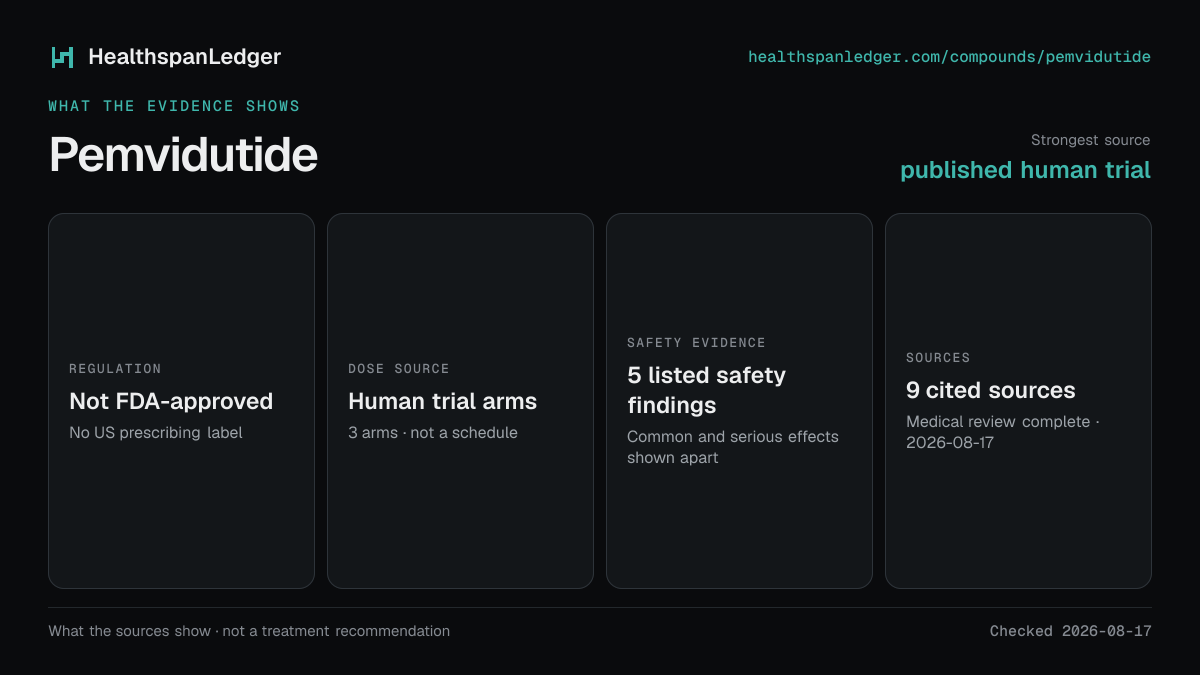
Pemvidutide at a glance: published human trial, dosing basis, regulatory status, safety coverage, and cited-source count. These details summarize the available sources; they are not treatment recommendations.
Evidence snapshot
Published human trial
The fastest way to see what kind of evidence this page is built on.
Regulation
Not FDA-approvedNo US prescribing label
Dose source
Human trial arms3 arms · not a schedule
Safety evidence
5 listed safety findingsCommon and serious effects shown apart
Pemvidutide at a glance: published human trial, dosing basis, regulatory status, safety coverage, and cited-source count. These details summarize the available sources; they are not treatment recommendations.
What each dose produced in the trial
These are the doses the trial gave and the weight change it reported for each one. It is a record of one experiment, not a schedule — no regulator has reviewed any of these doses.
Average weight change from the start of the trial, by weekly dose · the dashed rule marks placebo
1.2 mg−10.3%
1.8 mg−11.2%
2.4 mg−15.6%
Placebo−2.2%
4Exact trial values — 4 rows in the data table
Pemvidutide — 48-week MOMENTUM phase 2 obesity trial: average weight change from the start for each dose group
Once-weekly dose
Study group
Average weight change
What the paper notes
1.2 mg
Active
−10.3%
—
1.8 mg
Active
−11.2%
—
2.4 mg
Active
−15.6%
—
Placebo
Control
−2.2%
The group used to compare every active dose
What the source does not report for each dose group
The sponsor reported these average changes from baseline. Participants had obesity, or overweight plus another weight-related condition. None had diabetes.
Source: Altimmune 2024 Form 10-K — 48-week MOMENTUM phase 2 obesity results · retrieved 2026-08-17 · every value is quoted from that paper. Trial results describe averages across a study population, not an individual outcome.
Some bars are missing on purpose. Where the paper gives a range across arms instead of a figure per arm, that arm is left unplotted rather than filled in with a guess. The dashed line marks the placebo arm, so the part of each bar past it is the part the trial puts down to the drug rather than to being in a study.
10 registered studies; the program has reached phase 3, and one is still enrolling.
The soonest a running study expects to finish measuring people is September 2027. That is when the sponsor expects to finish collecting the main measurement. It is not a results date, and not a date anything goes on sale.
Phase 3Recruiting
Phase 3 Study of the Efficacy, Safety, and Clinical Outcomes of Pemvidutide in MASH
Altimmune, Inc. · Metabolic Dysfunction-Associated Steatohepatitis (MASH) · 1,800 participants planned · started July 2026
Main measurement due December 2028 (sponsor estimate)
RECLAIM STUDY: Phase 2 Study of the Efficacy and Safety of Pemvidutide in the Treatment of Alcohol Use Disorder (AUD) in Subjects With Obesity or Overweight
Altimmune, Inc. · Alcohol Use Disorder (AUD) · 100 participants · started May 2025
We left 6 registrations out of the count above. Registering a study does not prove it is running, and these did not hold up.
NCT00496860 — alias identity mismatch: matched only a non-primary development code, and lead sponsor “Altor BioScience” does not match a registry record linking that code to “pemvidutide”
NCT01029873 — alias identity mismatch: matched only a non-primary development code, and lead sponsor “Altor BioScience” does not match a registry record linking that code to “pemvidutide”
NCT01326871 — alias identity mismatch: matched only a non-primary development code, and lead sponsor “Altor BioScience” does not match a registry record linking that code to “pemvidutide”
NCT01478074 — alias identity mismatch: matched only a non-primary development code, and lead sponsor “Altor BioScience” does not match a registry record linking that code to “pemvidutide”
NCT01625260 — alias identity mismatch: matched only a non-primary development code, and lead sponsor “Altor BioScience” does not match a registry record linking that code to “pemvidutide”
NCT01670994 — alias identity mismatch: matched only a non-primary development code, and lead sponsor “Altor BioScience” does not match a registry record linking that code to “pemvidutide”
Check them yourself and disagree with us if you think we got it wrong.
A registered study means a sponsor filed a plan and started enrolling. It is not evidence the drug works, and most drugs tested in people never reach a pharmacy. Sponsors write and update these sources themselves; the National Library of Medicine publishes them without checking them.
It has no prescribing label or established dose. Its weight, liver and alcohol studies enrolled different groups and measured different results. The findings cannot be swapped between them.
The public PERFORMA update does not publish a dose. Starting phase 3 does not mean a drug is approved.
Experimental drug — no approved dose or prescribing label exists
Results announced by the company have not been peer reviewed
The weight, liver and alcohol studies ask different questions
Questions about Pemvidutide
Is Pemvidutide FDA-approved?
No. There is no prescribing label for it, so no approved dose exists — the regulatory status section above has the detail.
How is Pemvidutide taken?
By injection under the skin, once a week. The dosing page has every step, with the source on each row.
How does Pemvidutide differ from the other compounds in this class?
It acts at glucagon + GLP-1. Adding or removing a receptor changes the effect. It also changes how much people can tolerate. These molecules are not swappable at the same number of milligrams. Comparing them milligram for milligram is the most common mistake in this category.
The nearest alternatives act elsewhere:
Tirzepatide (GIP + GLP-1)
Semaglutide (GLP-1 alone)
Liraglutide (GLP-1 alone)
Retatrutide (GIP + GLP-1 + glucagon)
Cagrilintide (amylin)
VK2735 (GIP + GLP-1)
Zenagamtide (GLP-1 + amylin)
Brenipatide (GIP + GLP-1)
Eloralintide (amylin)
Enicepatide (GIP + GLP-1)
MariTide (GIP + GLP-1)
Petrelintide (amylin)
What is not known about Pemvidutide?
One trial cannot prove long-term safety or show that the result applies to everyone. The highest dose tested is a study dose, not a target for personal use.
For this compound specifically: The sponsor reported these average changes from baseline. Participants had obesity, or overweight plus another weight-related condition. None had diabetes.
Is there a Pemvidutide dosing schedule on this site?
Not a schedule — there is no approved schedule to publish here. What you get instead is the trial dosing program: the doses each arm received and how the protocol worked up to them. The studied range was 1.2–2.4 mg once a week for 48 weeks in MOMENTUM. See what the trials tested.
9primary sources, each with the day we read it — open the documents used on this page