Page last checked
Being studied in people · not FDA-approved
Mazdutide
Mazdutide is a once-weekly injection that works on two hormone receptors at once, GLP-1 and glucagon. It is the same class idea as tirzepatide, with a different second target.
What matters first
- Why people look it up
- In China it is prescribed for weight and for type 2 diabetes. Everywhere else it is sold online to people who want the newest weight-loss injection.
- What the evidence shows
- The trial program is large, and every trial in it was run in China. Two phase 3 trials compared it against placebo and reported substantial weight reduction. An independent review of nine trials says longer-term, multi-ethnic data is still needed. Nobody outside a Chinese pharmacy is getting the approved product.
- Dose status
- Mazdutide was given at 4–6 mg once a week, stepped up from 2 mg in four-week stages in the trials below. China approved it in June 2025 as Xinermei. The United States has not, and FDA holds no label for it. Nobody here has read the approved label either, so every number on this page is a trial arm rather than a schedule.
What is known about Mazdutide
Mazdutide is a once-weekly injection acting on two receptors at once, GLP-1 and glucagon. China approved it in June 2025 for weight, and in September 2025 for type 2 diabetes, where it sells as Xinermei. The United States has not approved it, and FDA holds no label for it. Its phase 3 obesity trials gave 4 mg and 6 mg a week, and one gave 9 mg. Innovent Biologics developed it with Eli Lilly, and registries file it as IBI362 and LY3305677.
| Topic | Value |
|---|---|
| Strongest source | Human trial |
| FDA approval | Not FDA-approved — approved in China since June 2025 as Xinermei |
| Studied dosing | 4–6 mg once weekly, stepped up from 2 mg in four-week stages — from clinical trials |
| Studied dosing | 9 mg once weekly for 60 weeks, the single arm of a second phase 3 trial, reached by a gradual climb the report does not detail — from clinical trials |
| Studied dosing | 4–6 mg once weekly for 24 weeks against placebo, then 24 weeks of open treatment; a separate trial ran the same doses against dulaglutide — from clinical trials |
| Studied dosing | 3–6 mg once weekly for 24 weeks across three arms, in the dose-finding trial that chose the doses every later trial used — from clinical trials |
| Studied dosing | 9–10 mg once weekly in four-week stages: 3 then 6 then 9 mg over twelve weeks, or 2.5 then 5 then 7.5 then 10 mg over sixteen — from clinical trials |
| Typical vials | 10 mg |
Every row links back to a source listed below. These facts are for reference, not a personal recommendation.
How Mazdutide works
Mazdutide acts at glucagon + GLP-1. Here is what that means.
This pairing drops GIP and keeps glucagon: one signal that cuts what you take in, one that raises what you burn. It is the most direct of the combinations, because the two hormones pull on opposite ends of the energy balance instead of pushing on the same end. It is also the pairing with the most obvious internal conflict, since glucagon works against the blood-sugar lowering it is packaged with.
| Receptor | Mazdutide | What it does |
|---|---|---|
| GLP-1 | Less appetite, slower stomach emptying, and insulin while blood sugar is rising. Here the insulin arm does double duty — it also counters glucagon’s tendency to push blood sugar up. | |
| GIP | — | |
| Glucagon | hepatocytesRaises how much energy you burn and makes the liver burn fat. That liver effect is why drugs in this class are also being tested in fatty-liver disease, not just for weight. | |
| Amylin | — |
The same four receptor groups are shown for every drug, so the differences are easy to compare. Targets come from the drug class. Any result specific to Mazdutide comes from the cited sources.
One arm raises blood sugar while the other pushes it down. The balance between them is the core of the design. It also means these drugs cannot be compared with incretin-only drugs milligram for milligram. Trials raise the dose slowly because both mechanisms need to be introduced over time. A shorter ramp-up is not what those trials tested.
What the evidence for Mazdutide is
These numbers come from a study in people that was published in a peer-reviewed journal. The drug or dose may still be experimental and may not have FDA approval.
The trial behind the numbers
48-week phase 3 obesity trial · 610 participants · 48 weeks
- What it establishes
- What it does not establish
Read each result with the study length, dose and number of participants. Results from separate trials are not a direct comparison because the people and study designs differ.
Evidence snapshot and shareable image
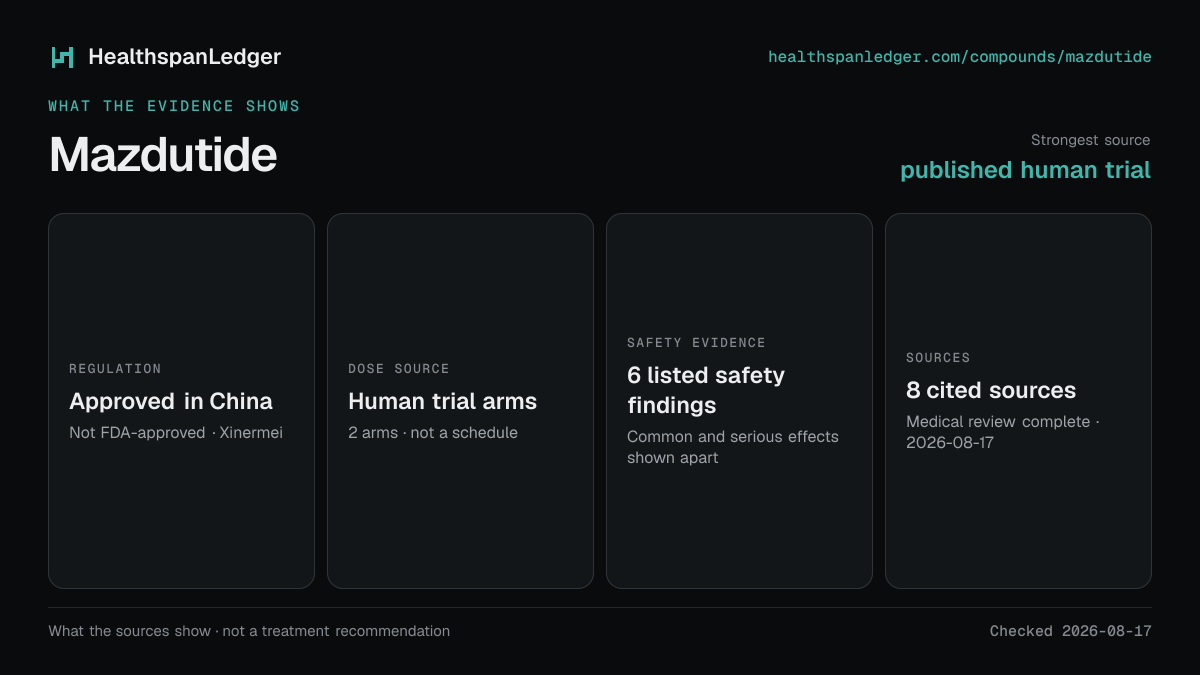
Evidence snapshot
Published human trial
- Regulation
- Dose source
- Safety evidence
- Sources
What each dose produced in the trial
These are the doses the trial gave and the weight change it reported for each one. It is a record of one experiment, not a schedule — no regulator has reviewed any of these doses.
Average weight change from the start of the trial, by weekly dose · the dashed rule marks placebo
| Once-weekly dose | Study group | Average weight change | What the paper notes |
|---|---|---|---|
| 4 mg | Active | −11.0% | 2 mg weekly for 4 weeks, then 4 mg weekly for 44 weeks. One step, held four weeks, then the rest of the year at the target. This is the lower of the two arms, the shorter climb, and the one that reached its dose soonest |
| 6 mg | Active | −14.0% | 2 mg for 4 weeks, then 4 mg for 4 weeks, then 6 mg weekly for 40 weeks. Two months of lower doses before this arm’s own dose begins, which is a sixth of the trial spent under the amount the arm is named for |
| Placebo | Control | +0.3% | The group used to compare every active dose |
What the source does not report for each dose group
Source: Ji L et al. Once-Weekly Mazdutide in Chinese Adults with Obesity or Overweight. N Engl J Med 2025;392:2215-2225 (GLORY-1, NCT05607680, PMID 40421736) · retrieved 2026-08-17 · every value is quoted from that paper. Trial results describe averages across a study population, not an individual outcome.
Where Mazdutide is in clinical trials
43 registered studies; the program has reached phase 4, and 9 are still enrolling.
The soonest a running study expects to finish measuring people is September 2026. That is when the sponsor expects to finish collecting the main measurement. It is not a results date, and not a date anything goes on sale.
- Phase 4Recruiting
- Phase 4Not yet recruiting
- Phase 4Not yet recruiting
ClinicalTrials.gov · retrieved 2026-09-27
Regulatory status
This is the one compound on this site approved somewhere and not here.
China approved mazdutide in June 2025 for weight, and in September 2025 for type 2 diabetes. It is sold there as Xinermei. That approval governs a Chinese pharmacy and nothing else.
FDA has approved no mazdutide product, and a Drugs@FDA search on 13 August 2026 found nothing under any of its four names. The drug is dispensed under supervision several thousand miles away. Anything reaching a US reader outside that is unapproved and unchecked.
No schedule is copied from the Chinese label, because nobody here has read it.
Full regulatory tracker →Where to go next on Mazdutide
The related pages keep each topic with its evidence.
Which mazdutide amounts the trials actually gave
When mazdutide reactions tend to appear
Mazdutide concentration in the mazdutide dosage calculator
What each water volume does to the 10 mg mazdutide vial
Who else is sold for weight loss besides mazdutide
Check the same draw on a vial that is not mazdutide
The source-checked VK2735 entry, beyond the mazdutide one
What the tirzepatide page carries, separate from mazdutide
What the brenipatide page carries, separate from mazdutide
What the enicepatide page carries, separate from mazdutide
Safety notes
Questions about Mazdutide
Is Mazdutide FDA-approved?
How is Mazdutide taken?
How does Mazdutide differ from the other compounds in this class?
What is not known about Mazdutide?
Is there a Mazdutide dosing schedule on this site?
- Ji L et al. Once-Weekly Mazdutide in Chinese Adults with Obesity or Overweight. N Engl J Med 2025;392:2215-2225 (GLORY-1, NCT05607680, PMID 40421736)retrieved 2026-08-17Human trial
- Gao L et al. Treatment With 9-mg Mazdutide for Weight Reduction in Chinese Adults With Obesity: The GLORY-2 Randomized Clinical Trial. JAMA 2026;336(5):377-388 — 60 weeks, ClinicalTrials.gov NCT06164873 (PMID 42251595)retrieved 2026-08-17Human trial
- Zhu D, Zhao J et al. Mazdutide versus placebo in Chinese adults with type 2 diabetes. Nature 2026;652:174-180 — a 24-week phase 3 trial of 4 mg and 6 mg weekly, followed by 24 weeks of open treatment (PMID 41407859)retrieved 2026-08-17Human trial
- Ji L, Jiang H et al. A phase 2 randomized controlled trial of mazdutide in Chinese overweight adults or adults with obesity. Nat Commun 2023;14:8289 — 248 participants across 3 mg, 4.5 mg and 6 mg arms over 24 weeks, ClinicalTrials.gov NCT04904913 (PMID 38092790)retrieved 2026-08-17Human trial
- Ji L, Gao L et al. Safety and efficacy of a GLP-1 and glucagon receptor dual agonist mazdutide (IBI362) 9 mg and 10 mg in Chinese adults with overweight or obesity: a randomised, placebo-controlled, multiple-ascending-dose phase 1b trial. EClinicalMedicine 2022;54:101691 (PMID 36247927)retrieved 2026-08-17Human trial
- Kamrul-Hasan ABM et al. Efficacy and Safety of the Dual GLP-1 and Glucagon Receptor Agonist Mazdutide in Predominantly Chinese Adults With Obesity and/or Type 2 Diabetes: A Systematic Review and Meta-Analysis. Diabetes Obes Metab 2026 — nine randomized trials, 2,292 participants, no manufacturer authorship (PMID 42410325)retrieved 2026-08-17Human trial
- NCT06164873 — A Study of IBI362 9 mg in Chinese Adults With Obesity (GLORY-2)retrieved 2026-08-17Human trial
- Shirley M. Mazdutide: First Approval. Drugs 2025;85(12):1621-1627 — records the June 2025 Chinese approval for weight management and the September 2025 Chinese approval for type 2 diabetes, and the trade name Xinermei (PMID 41028652)retrieved 2026-08-17limited human data