Page last checked
Being studied in people · not FDA-approved
Eloralintide
Eloralintide is an experimental weekly shot for weight loss. It works on amylin receptors, not GLP-1.
What matters first
- Why people look it up
- Researchers are studying Eloralintide for weight loss.
- What the evidence shows
- A Phase 2 trial reported average weight loss across six study groups. A larger Phase 3 trial is recruiting, so there is no approved dose or launch date.
- Dose status
- Trials tested Eloralintide at 1–9 mg once a week for 48 weeks in Phase 2; four fixed-dose groups and two study-set paths ending at 9 mg. There is no FDA-approved dose or dosing label. Every number below is a trial arm, not a treatment schedule.
What is known about Eloralintide
Eloralintide is an experimental weekly shot for weight loss. It works on amylin receptors, not GLP-1. In a 263-person Phase 2 trial, average weight change after 48 weeks ranged from 9.4% to 20.1% across six study groups, compared with 0.4% for placebo. A larger Phase 3 trial is recruiting, so there is no approved dose or launch date.
| Topic | Value |
|---|---|
| Strongest source | Human trial |
| FDA approval | Not FDA-approved |
| Studied dosing | 1–9 mg once weekly for 48 weeks in Phase 2; four fixed-dose groups and two study-set paths ending at 9 mg — from clinical trials |
| Presentation | Eloralintide has no approved vial or mixing instructions; its trials use prepared study injections. |
Every row links back to a source listed below. These facts are for reference, not a personal recommendation.
How Eloralintide works
Eloralintide acts at amylin. Here is what that means.
Amylin is not a gut hormone, and this is the one class here that does not act on a gut hormone receptor at all. Your pancreas releases amylin alongside insulin, and its job is to say the meal is over. Natural amylin clumps together and clears fast. A long-acting version is rebuilt to be stable enough for a weekly injection. It holds a signal that normally lasts one meal across several days.
| Receptor | Eloralintide | What it does |
|---|---|---|
| GLP-1 | — | |
| GIP | — | |
| Glucagon | — | |
| Amylin | area postrema and hindbrainAmylin works mainly on a small brainstem region that sits outside the blood-brain barrier and samples the blood directly. Switching it on produces fullness — the feeling that ends a meal — rather than damping hunger in the gaps between meals. That is a different lever from the gut-hormone one. | |
| Gastric and islet effects | Amylin also slows stomach emptying and holds back the rise in glucagon after a meal, working alongside insulin on the same meal rather than repeating it. |
The same four receptor groups are shown for every drug, so the differences are easy to compare. Targets come from the drug class. Any result specific to Eloralintide comes from the cited sources.
Amylin and GLP-1 signals help fullness in different ways. That is why researchers combine the two instead of only raising one dose. The side effects can also differ, so results from a GLP-1 drug do not automatically carry over to an amylin drug.
What the evidence for Eloralintide is
These numbers come from a study in people that was published in a peer-reviewed journal. The drug or dose may still be experimental and may not have FDA approval.
The trial behind the numbers
48-week Phase 2 weight-management trial · 263 participants · 48 weeks
- What it establishes
- What it does not establish
Read each result with the study length, dose and number of participants. Results from separate trials are not a direct comparison because the people and study designs differ.
Evidence snapshot and shareable image
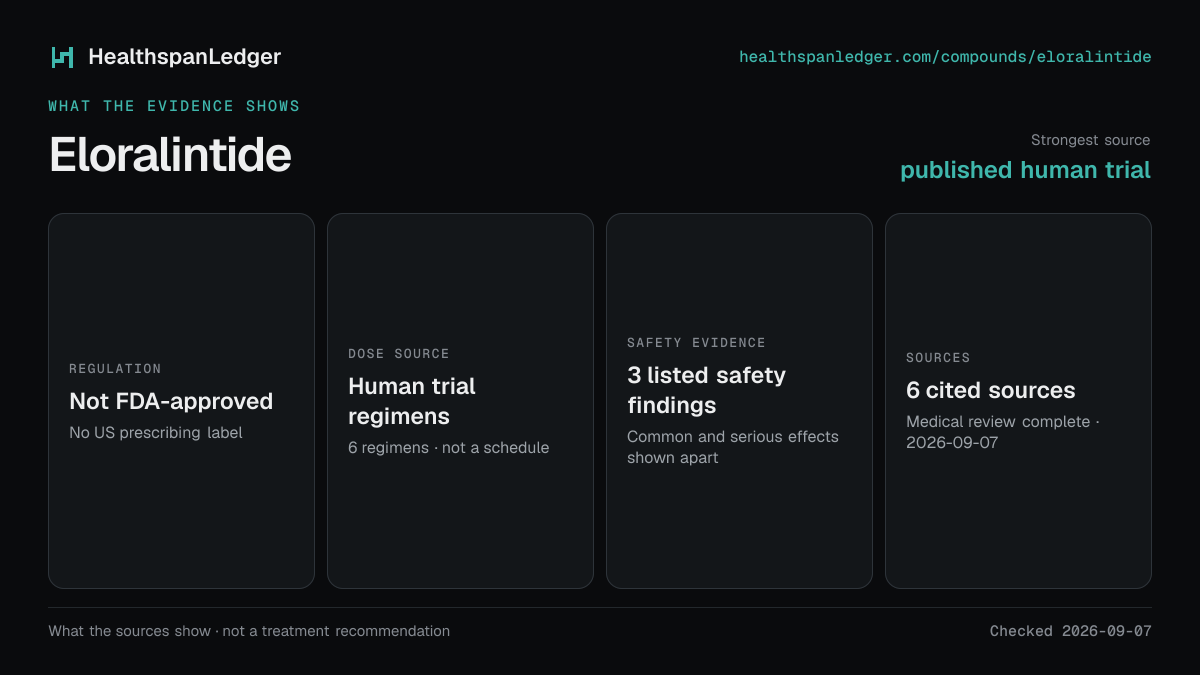
Evidence snapshot
Published human trial
- Regulation
- Dose source
- Safety evidence
- Sources
What each dose produced in the trial
These are the doses the trial gave and the weight change it reported for each one. It is a record of one experiment, not a schedule — no regulator has reviewed any of these doses.
Average weight change from the start of the trial, by weekly dose · the dashed rule marks placebo
| Once-weekly dose | Study group | Average weight change | What the paper notes |
|---|---|---|---|
| 1 mg | Active | −9.4% | — |
| 3 mg | Active | −12.4% | — |
| 6 mg | Active | −17.6% | — |
| 9 mg | Active | −20.1% | — |
| 9 mg | Active | −19.9% | — |
| 9 mg | Active | −16.5% | — |
| Placebo | Control | −0.4% | The group used to compare every active dose |
What the source does not report for each dose group
Source: NCT06230523 — 48-week Phase 2 Eloralintide trial · retrieved 2026-08-29 · every value is quoted from that paper. Trial results describe averages across a study population, not an individual outcome.
Where Eloralintide is in clinical trials
22 registered studies; the program has reached phase 3, and 12 are still enrolling.
The soonest a running study expects to finish measuring people is October 2026. That is when the sponsor expects to finish collecting the main measurement. It is not a results date, and not a date anything goes on sale.
- Phase 3Recruiting
- Phase 3Recruiting
- Phase 3Recruiting
ClinicalTrials.gov · retrieved 2026-09-27
Regulatory status
Eloralintide is investigational.
It has no prescribing label or approved dose. The amounts below belong to monitored study groups and are not a schedule for personal use. A recruiting Phase 3 study has no results yet.
Full regulatory tracker →Where to go next on Eloralintide
The related pages keep each topic with its evidence.
Eloralintide dosing evidence, without an approved schedule
Which eloralintide reactions warrant medical attention
The source-checked brenipatide entry, beyond the eloralintide one
The source-checked enicepatide entry, beyond the eloralintide one
MariTide in the full list, alongside eloralintide
Take the eloralintide arithmetic to any other vial
What the VK2735 page carries, separate from eloralintide
Pemvidutide on its own page, separate from eloralintide
Mazdutide in the full list, alongside eloralintide
Zenagamtide in the full list, alongside eloralintide
Safety notes
Questions about Eloralintide
Is Eloralintide FDA-approved?
How is Eloralintide taken?
How does Eloralintide differ from the other compounds in this class?
What is not known about Eloralintide?
Is there a Eloralintide dosing schedule on this site?
- Eli Lilly and Company — what to know about Eloralintideretrieved 2026-08-29Company investigational-program overview
- Eli Lilly and Company research and development pipelineretrieved 2026-08-29Current company development pipeline
- Briere DA et al. Eloralintide from discovery to clinical proof of concept (PMID 41109426)retrieved 2026-08-29Human trial
- Billings LK et al. Eloralintide for obesity: 48-week Phase 2 trial (PMID 41207310)retrieved 2026-09-07Human trial
- NCT06230523 — 48-week Phase 2 Eloralintide trialretrieved 2026-08-29Human trial
- NCT07321886 — recruiting Phase 3 Eloralintide weight-management trialretrieved 2026-08-29Human trial