Page last checked
Research compound · not FDA-approved
GHK-Cu
GHK-Cu is a peptide three amino acids long holding a copper ion. It was pulled out of human blood plasma in 1973.
What matters first
- Why people look it up
- It is sold for skin — wrinkles, firmness, scars — and for hair regrowth, and now increasingly as an injection.
- What the evidence shows
- Almost everything published is a cream on the surface of the skin. Where that work was blinded and measured objectively, the copper peptide did no better than its control. A 2026 review of injectable peptides says the dose, the frequency and the indications for injecting this one all remain unknown.
- Dose status
- GHK-Cu is not FDA-approved, so no dosing label exists for it. The sections below explain what researchers tested and what remains unknown.
What is known about GHK-Cu
GHK-Cu is a three-amino-acid peptide holding a copper ion. Researchers first found it in human blood plasma in 1973; the copper-peptide pair is the active form. Blood levels fall from early adulthood into later life. Most published studies used it on the surface of the skin. In a small study after laser treatment, blinded skin assessments found no significant benefit over the control, while patients reported greater satisfaction.
| Topic | Value |
|---|---|
| Strongest source | indirect evidence |
| FDA approval | Not FDA-approved |
| Typical vials | 50 mg |
Every row links back to a source listed below. These facts are for reference, not a personal recommendation.
What the evidence for GHK-Cu is
The number comes from reported practice or animal research, not a controlled trial in people. An animal dose converted by body weight is still not a tested human dose.
- What it establishes
- What it does not establish
Treat the number as reported practice or animal research, not as a recommendation or a proven human dose.
Evidence snapshot and shareable image
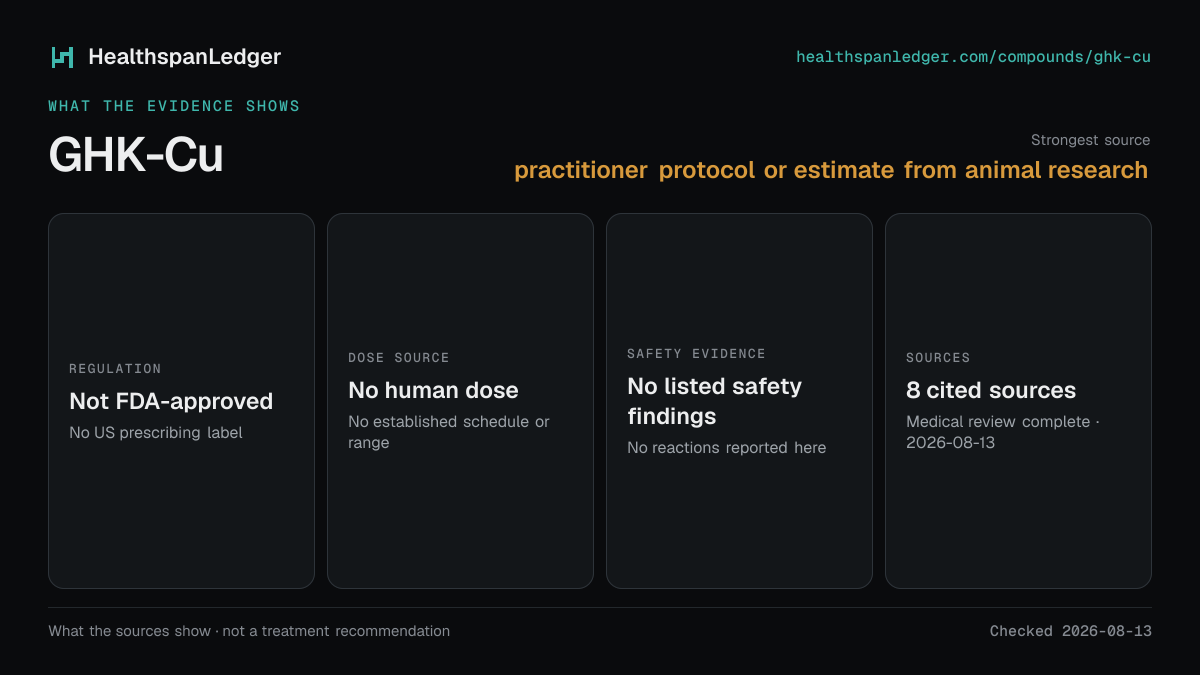
Evidence snapshot
Practitioner protocol or estimate from animal research
- Regulation
- Dose source
- Safety evidence
- Sources
Where GHK-Cu is in clinical trials
No trial of this compound is registered on ClinicalTrials.gov.
That is worth sitting with. Nobody has registered a study to find out whether GHK-Cu works in people, so no result is coming and no date is worth waiting for. Sellers are not waiting for that work either.
We left one registration out of the count above. Registering a study does not prove it is running, and these did not hold up.
ClinicalTrials.gov · retrieved 2026-09-27
Regulatory status
Under the name copper tripeptide-1, this molecule is a known cosmetic ingredient.
That framework reviews neither whether it works nor how much gets into the body. Its clearance says nothing about an injection. One US regulator has looked at this molecule, and only at the injection.
FDA’s entry covers injectable routes explicitly, citing aggregation, impurities and limited human data. Whoever asked for it later withdrew, so FDA files it under nominated but withdrawn. The route stays open: FDA has named GHK-Cu for a compounding committee meeting before the end of February 2027.
Full regulatory tracker →Where to go next on GHK-Cu
The related pages keep each topic with its evidence.
GHK-Cu and the limits of animal findings
Doses per 50 mg GHK-Cu vial in the GHK-Cu dosage calculator
GHK-Cu and Australia’s Peptide products pathway
GHK-Cu, then the formula-level skin evidence
GHK-Cu and Canada’s Peptide products pathway
Where GHK-Cu sits among the skin compounds
What GHK-Cu is doing in a KLOW vial
What GHK-Cu is doing in a GLOW vial
Where GHK-Cu sits among the longevity compounds
Compare the GHK-Cu schedule against the others
Safety notes
Questions about GHK-Cu
Is GHK-Cu FDA-approved?
How is GHK-Cu taken?
How does GHK-Cu differ from the other compounds in this class?
What is not known about GHK-Cu?
- A prospective randomized evaluator-blinded trial of two potential wound healing agents for the treatment of venous stasis ulcersretrieved 2026-09-13limited human data
- Effects of topical copper tripeptide complex on CO2 laser-resurfaced skinretrieved 2026-09-13limited human data
- Certain Bulk Drug Substances for Use in Compounding that May Present Significant Safety Risksretrieved 2026-08-14indirect evidence
- Androgenetic Alopecia Treatment in Asian Menretrieved 2026-08-14limited human data
- Intradermal injections of a hair growth factor formulation for enhancement of human hair regrowth - safety and efficacy evaluation in a first-in-man pilot clinical study.retrieved 2026-08-14limited human data
- Injectable Peptide Therapy: A Primer for Orthopaedic and Sports Medicine Physicians.retrieved 2026-08-14indirect evidence
- GHK Peptide as a Natural Modulator of Multiple Cellular Pathways in Skin Regenerationretrieved 2026-08-14indirect evidence
- Glycyl-L-histidyl-L-lysine-Cu2+ attenuates cigarette smoke-induced pulmonary emphysema and inflammation by reducing oxidative stress pathwayretrieved 2026-08-14indirect evidence
- Tripeptide-copper complex GHK-Cu (II) transiently improved healing outcome in a rat model of ACL reconstruction.retrieved 2026-08-14indirect evidence
- Expression of glycosaminoglycans and small proteoglycans in wounds: modulation by the tripeptide-copper complex glycyl-L-histidyl-L-lysine-Cu(2+).retrieved 2026-08-14indirect evidence