KPV is three amino acids — lysine, proline, valine. They are the tail end of the hormone that controls skin pigment.
What matters first
Why people look it up
It is sold for gut inflammation, and for eczema and other inflamed skin.
What the evidence shows
The interest behind that is real but narrow. In mice given colitis chemically, and in colon cells in a dish, it quietens inflammatory signaling. The FDA states it has found no data on any person receiving it, by any route.
Dose status
No completed controlled human trial has shown which dose works for KPV. A few people may have received it in small reports, but that cannot show which dose works. The sections below separate study findings from what people report using.
KPV is a three-amino-acid fragment of alpha-melanocyte-stimulating hormone. In mouse and cell studies, it reduced signals tied to inflammation without causing the pigment effects linked to other parts of the hormone. The mouse work used chemically induced colitis. The cell work used colon cells. No human trial has tested KPV, which FDA also reports.
KPV research and regulatory details: evidence quality, approval status, doses, handling, and presentation.
Topic
Value
Strongest source
no human dose shown to work
FDA approval
Not FDA-approved
Typical vials
5 mg · 10 mg
Every row links back to a source listed below. These facts are for reference, not a personal recommendation.
What the evidence for KPV is
No completed controlled human trial has shown which dose works. People may report using a range, but that is not a tested dosing schedule.
no human dose shown to work
What it establishes
Animal studies or small reports can show that researchers are exploring the compound. They cannot show which dose works in people.
What it does not establish
A validated dose, schedule, duration, safety margin, or reliable figure for how long it stays in the body.
If a number appears, it describes what people report using. It is not a trial result or a recommendation. If there is no number, no study has produced one.
Evidence snapshot and shareable image
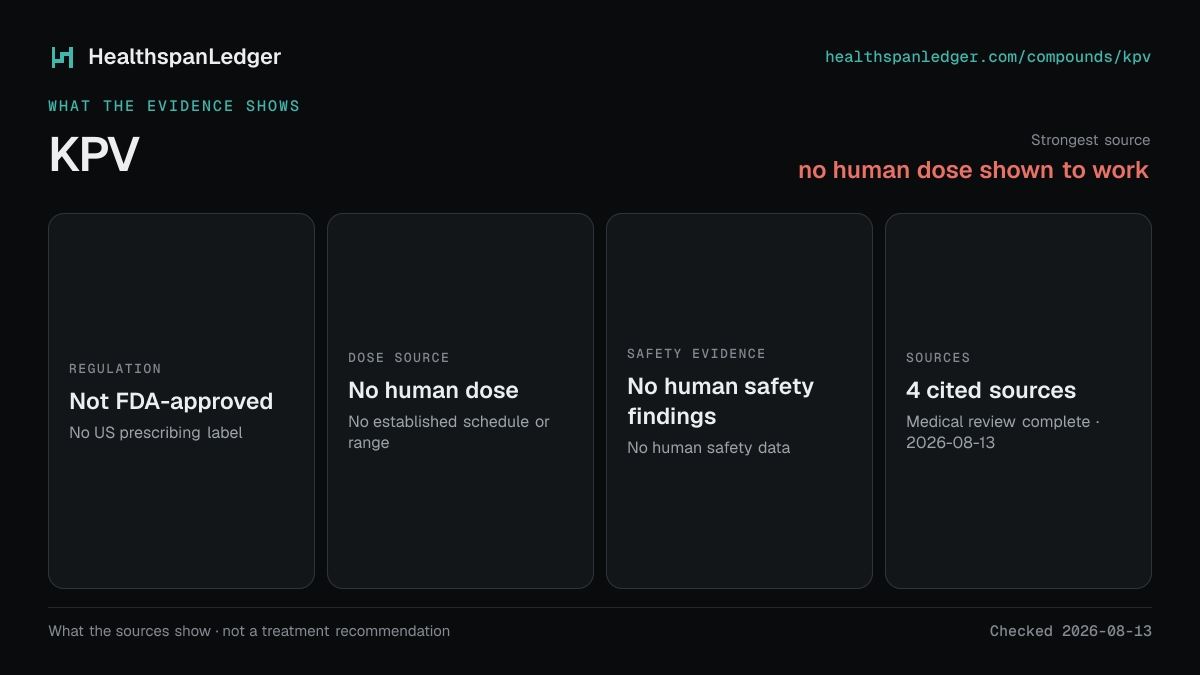
KPV at a glance: no human dose shown to work, dosing basis, regulatory status, safety coverage, and cited-source count. These details summarize the available sources; they are not treatment recommendations.
Evidence snapshot
No human dose shown to work
The fastest way to see what kind of evidence this page is built on.
Regulation
Not FDA-approvedNo US prescribing label
Dose source
No dose listedSee the guide for evidence limits
Safety evidence
No safety findings listedAn empty list does not establish safety
KPV at a glance: no human dose shown to work, dosing basis, regulatory status, safety coverage, and cited-source count. These details summarize the available sources; they are not treatment recommendations.
Where KPV is in clinical trials
No trial of this compound is registered on ClinicalTrials.gov.
That is worth sitting with. Nobody has registered a study to find out whether KPV works in people, so no result is coming and no date is worth waiting for. Sellers are not waiting for that work either.
A registered study means a sponsor filed a plan and started enrolling. It is not evidence the drug works, and most drugs tested in people never reach a pharmacy. Sponsors write and update these sources themselves; the National Library of Medicine publishes them without checking them.
So nothing about alpha-MSH research carries over to this tripeptide, in law or in evidence. No regulator has approved it, and no pharmacopeia lists it. FDA lists KPV under substances nominated but withdrawn, once in category 2.
The agency recorded no human exposure data for it, by any route. The nominator withdrew, and FDA took it to the advisory committee on 23 July 2026 regardless. The uses reviewed were wound healing and inflammatory conditions.
The FDA states it has not identified any human exposure data for KPV taken in any way
Evidence is chemically induced colitis in mice and cultured colonic epithelial cells; no human trial of any kind exists
The FDA’s own July 2026 briefing document records that the nominator’s nine references included no study of KPV given to a person, and that its side-effect report search through 3 December 2025 returned nothing at all
The animal quantities are almost all oral: 100 micromolar in mouse drinking water, and 16 micrograms per kilogram a day by gavage inside nanoparticles built to protect the peptide through the gut. There is no subcutaneous regimen in any species, and this vial is sold for an injection under the skin
The concentration most often quoted for it, 10 nanomolar, is a figure from cells in a dish. It is not a dose and does not convert into one
Current research is still solving how to protect the peptide through a rodent gut, which is several stages before a human dose
Nothing is known about how long it lasts in a person, what it does at any quantity, or what it does repeatedly
Oral, topical and injected presentations are sold under one name and do not deliver comparable exposure
A three-residue peptide is cheap to counterfeit and difficult to identify by inspection
Questions about KPV
Is KPV FDA-approved?
No. There is no prescribing label for it, so no approved dose exists — the regulatory status section above has the detail.
How is KPV taken?
No completed controlled human trial has established a dose, frequency, or route, so no human schedule is published.
How does KPV differ from the other compounds in this class?
KPV works through a different system from GLP-1 and amylin drugs. No completed human study has set a dose, so a direct comparison would be misleading.
What is not known about KPV?
A validated dose, schedule, duration, safety margin, or reliable figure for how long it stays in the body.
Questions readers ask
Who should not take KPV peptide?
Nobody has published an answer. FDA states it has not identified any human exposure data for KPV, by any route. With no study behind it, nobody has ever identified a group at risk.
KPV is the last three pieces of alpha-melanocyte-stimulating hormone. Interest in it comes from colitis mice and cultured gut cells, and that is where the page still sits.
Does KPV help with weight loss?
No published work points that way. The research is about inflammation: colitis brought on chemically in mice, scored by colon shortening, tissue damage and inflammatory signals.
Nothing in that literature set out to measure body weight, and none of it involved a person. There is no human study of KPV of any kind, for weight or for anything else.
How often should I take KPV peptide?
No published schedule exists for people, at any frequency. The animal quantities are nearly all by mouth. Mice got a hundred micromolar in drinking water, or sixteen micrograms per kilogram a day by gavage inside protective nanoparticles.
Neither converts into a human frequency. No injected regimen exists in any species, and this vial is sold for an injection under the skin.
How does KPV peptide compare to BPC-157?
Both are unstudied in people, but the shapes of the two gaps differ. FDA has recorded that it found nothing documenting KPV given to a person. BPC-157 has reached people — fewer than thirty of them, across three uncontrolled pilots by one clinician.
The research settings differ too. KPV work is colitis mice and cultured gut cells, still solving how to get the peptide through a rodent stomach. Published BPC-157 quantities went into a vein, a bladder wall or a knee joint.
4primary sources, each with the day we read it — open the documents used on this page