BPC-157 is a lab-made peptide, fifteen amino acids long, copied from one short stretch of a protein found in human stomach juice.
What matters first
Why people look it up
People take it hoping to heal faster — tendon and ligament injuries, muscle tears, and gut conditions such as inflammatory bowel disease.
What the evidence shows
Nearly all of that comes from rats and mice. Three small reports describe people receiving it, none with a comparison group, and between them they cover fewer than 30 subjects. None of the three tested a healing injury, and none used an injection under the skin.
Dose status
No completed controlled human trial has shown which dose works for BPC-157. A few people may have received it in small reports, but that cannot show which dose works. The sections below separate study findings from what people report using.
BPC-157 is a lab-made peptide studied mostly in animals. FDA has not approved it, and no controlled human trial has found a working dose. The ranges shared online were estimated from animal studies, not tested in people. The three published human reports included fewer than 30 people in total. None had a control group, and none used the under-the-skin route these vials are sold for.
BPC-157 research and regulatory details: evidence quality, approval status, doses, handling, and presentation.
Topic
Value
Strongest source
no human dose shown to work
FDA approval
Not FDA-approved
What people report using
200–500 mcg a day, by injection under the skin or by mouth; the review says this came from animal data, not a human dosing study— no trial has tested this quantity
Typical vials
5 mg · 10 mg
Every row links back to a source listed below. These facts are for reference, not a personal recommendation.
The row headed “what people report using” is not evidence. No trial produced that quantity. It is printed because it is what circulates, and because it is better read here, beside what the studies actually did, than on a page that is selling the vial. It describes a practice. It is not a starting point.
What the evidence for BPC-157 is
No completed controlled human trial has shown which dose works. People may report using a range, but that is not a tested dosing schedule.
no human dose shown to work
What it establishes
Animal studies or small reports can show that researchers are exploring the compound. They cannot show which dose works in people.
What it does not establish
A validated dose, schedule, duration, safety margin, or reliable figure for how long it stays in the body.
If a number appears, it describes what people report using. It is not a trial result or a recommendation. If there is no number, no study has produced one.
Evidence snapshot and shareable image
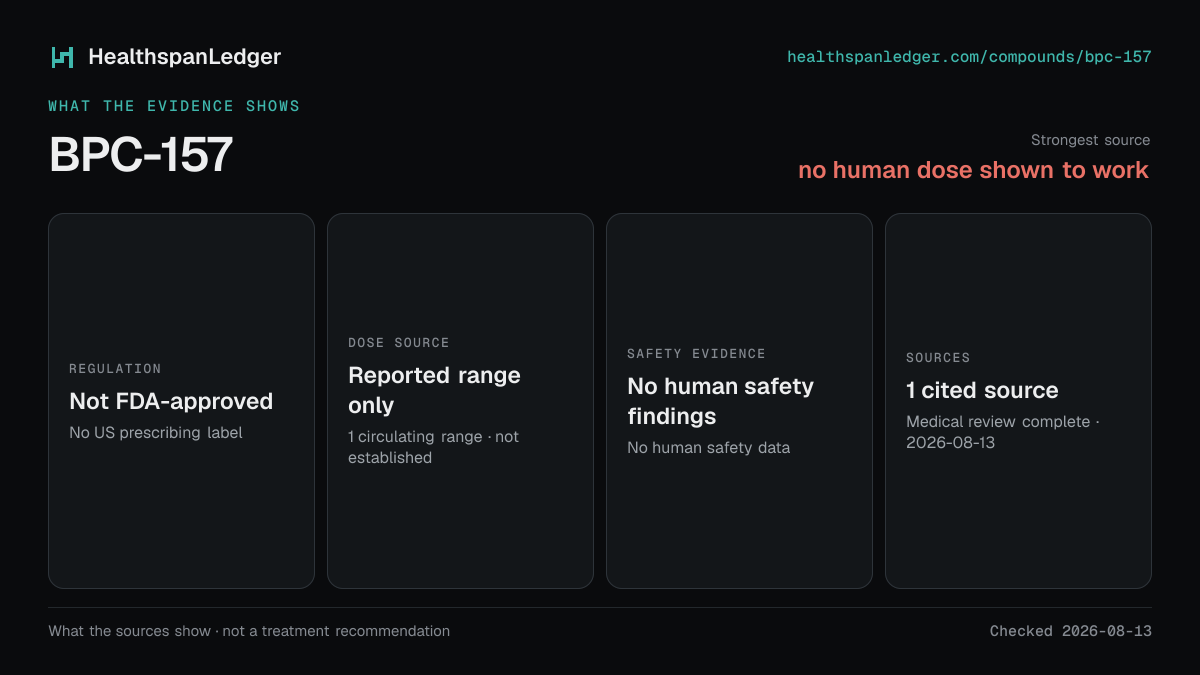
BPC-157 at a glance: no human dose shown to work, dosing basis, regulatory status, safety coverage, and cited-source count. These details summarize the available sources; they are not treatment recommendations.
Evidence snapshot
No human dose shown to work
The fastest way to see what kind of evidence this page is built on.
Regulation
Not FDA-approvedNo US prescribing label
Dose source
Reported range only1 circulating range · not established
Safety evidence
No safety findings listedAn empty list does not establish safety
BPC-157 at a glance: no human dose shown to work, dosing basis, regulatory status, safety coverage, and cited-source count. These details summarize the available sources; they are not treatment recommendations.
Where BPC-157 is in clinical trials
2 registered studies; the program has reached phase 1. Studies are running, but none is taking new participants.
The soonest a running study expects to finish measuring people is August 2027. That is when the sponsor expects to finish collecting the main measurement. It is not a results date, and not a date anything goes on sale.
Phase 1Not yet recruiting
Impact of BPC-157 on Recovery Following Rotator Cuff Repair Surgery
University of Arkansas · Rotator Cuff Tear · 30 participants planned · started January 2027
Main measurement due August 2027 (sponsor estimate)
We left one registration out of the count above. Registering a study does not prove it is running, and these did not hold up.
NCT07437547 — template batch: 7 of 8 studies from “Hudson Biotech” claim the same primary completion date 2027-02-14, all at Peking University Shenzhen Hospital; NCT07481734 declares itself an example
Check them yourself and disagree with us if you think we got it wrong.
A registered study means a sponsor filed a plan and started enrolling. It is not evidence the drug works, and most drugs tested in people never reach a pharmacy. Sponsors write and update these sources themselves; the National Library of Medicine publishes them without checking them.
Not FDA-approved, and not legal to compound for people.
Two parties asked FDA to allow BPC-157 in compounding, and both later withdrew. FDA’s page now lists it under substances nominated but withdrawn, which it describes as once in category 2. The agency found too little data to know whether it would harm people.
FDA took it to the Pharmacy Compounding Advisory Committee anyway on 23 July 2026, and its briefing document says so. Ulcerative colitis was the use reviewed. A withdrawal is not a finding against the drug.
It closes a route and settles nothing about safety.
No controlled human trial has shown which dose works
Not FDA-approved; sold as a research compound
The 200 to 500 micrograms a day shown here is not a studied dose. A 2026 review says it came from animal data without a human safety check
A second 2026 review gives a wider range of 200 to 1000 micrograms a day. Neither range comes from a controlled human study
The published human evidence consists of three small reports involving fewer than 30 people. None had a control group, and all three came from the same clinician and journal
FDA guidance now states the agency will not place substances nominated on or after 7 January 2025 into these compounding categories at all
Published doses went into a vein, a bladder wall or a knee joint. No human study used an injection under the skin
One report used 10 mg in the bladder wall in 12 women. Another infused 10 mg and then 20 mg in 2 people
The often-repeated Croatian phase 2 in inflammatory bowel disease has no published trial report and no registry record carrying results
Measured half-life is under 30 minutes, while the effects claimed for it are described in hours to days — a gap nobody has explained
The FDA states it lacks enough information to know whether BPC-157 would cause harm when given to people
Questions about BPC-157
Is BPC-157 FDA-approved?
No. There is no prescribing label for it, so no approved dose exists — the regulatory status section above has the detail.
How is BPC-157 taken?
No completed controlled human trial has established a dose, frequency or route. A separately labeled protocol from reported practice is available, but it is not study dosing. The reported cadence is a day, by injection under the skin or by mouth.
How does BPC-157 differ from the other compounds in this class?
BPC-157 works through a different system from GLP-1 and amylin drugs. No completed human study has set a dose, so a direct comparison would be misleading.
What is not known about BPC-157?
A validated dose, schedule, duration, safety margin, or reliable figure for how long it stays in the body.
Is there a BPC-157 dosing schedule on this site?
Not a schedule — there is no approved schedule to publish here. What you get instead is the trial dosing program: the doses each arm received and how the protocol worked up to them. See what the trials tested.
1primary source, each with the day we read it — open the documents used on this page