TB-500 is a code name for material sold as thymosin beta-4, a protein your body releases where you are injured. The FDA says what is sold under the name is a seven-amino-acid piece of that protein.
What matters first
Why people look it up
People buy it for the same injuries as BPC-157 — tendon, muscle and joint — and often buy the two together.
What the evidence shows
The full protein has been given to people in trials for eye, wound and heart conditions. The short piece sold as TB-500 has not. The FDA states it found no record of any person receiving it, by any route.
Dose status
TB-500 is not FDA-approved, so no dosing label exists for it. The sections below explain what researchers tested and what remains unknown.
Thymosin beta-4 is a 43-amino-acid protein released at injury sites, where it helps control cell movement and blood-vessel growth. TB-500 is the name used for material sold as that protein. FDA identifies the sold substance as a seven-amino-acid fragment called LKKTETQ. The full protein reached human trials for eye, wound, and heart conditions; the fragment did not. FDA says it found no record of any person receiving that fragment by any route.
TB-500 research and regulatory details: evidence quality, approval status, doses, handling, and presentation.
Topic
Value
Strongest source
indirect evidence
FDA approval
Not FDA-approved
Typical vials
5 mg · 10 mg
Every row links back to a source listed below. These facts are for reference, not a personal recommendation.
What the evidence for TB-500 is
The number comes from reported practice or animal research, not a controlled trial in people. An animal dose converted by body weight is still not a tested human dose.
indirect evidence
What it establishes
It only shows what some people report using or what researchers tested in animals.
What it does not establish
It does not show that the amount works or is safe in people. Animal and human bodies can handle the same compound differently.
Treat the number as reported practice or animal research, not as a recommendation or a proven human dose.
Evidence snapshot and shareable image
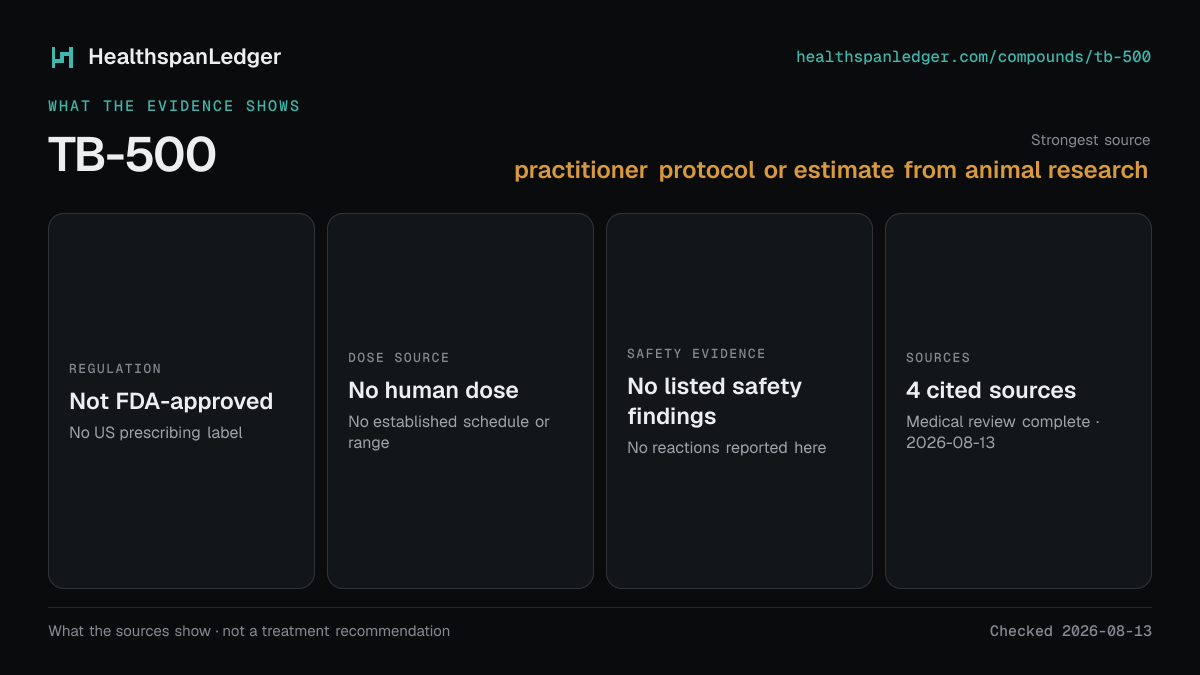
TB-500 at a glance: practitioner protocol or estimate from animal research, dosing basis, regulatory status, safety coverage, and cited-source count. These details summarize the available sources; they are not treatment recommendations.
Evidence snapshot
Practitioner protocol or estimate from animal research
The fastest way to see what kind of evidence this page is built on.
Regulation
Not FDA-approvedNo US prescribing label
Dose source
No dose listedSee the guide for evidence limits
Safety evidence
No safety findings listedAn empty list does not establish safety
TB-500 at a glance: practitioner protocol or estimate from animal research, dosing basis, regulatory status, safety coverage, and cited-source count. These details summarize the available sources; they are not treatment recommendations.
Where TB-500 is in clinical trials
No trial of this compound is registered on ClinicalTrials.gov.
That is worth sitting with. Nobody has registered a study to find out whether TB-500 works in people, so no result is coming and no date is worth waiting for. Sellers are not waiting for that work either.
We left one registration out of the count above. Registering a study does not prove it is running, and these did not hold up.
NCT07487363 — self-declared example: brief summary declares itself an example (“fictional”)
Check them yourself and disagree with us if you think we got it wrong.
A registered study means a sponsor filed a plan and started enrolling. It is not evidence the drug works, and most drugs tested in people never reach a pharmacy. Sponsors write and update these sources themselves; the National Library of Medicine publishes them without checking them.
The parent protein reached clinical development, which is why this compound sounds better sourced than it is.
Those programs ran as eye drops, gels and an intravenous cardiac formulation. None of them was a vial, and none reached approval. FDA lists the LKKTETQ fragment under substances nominated but withdrawn, once in category 2.
It cited aggregation risk and no human exposure data. The nominator withdrew, and FDA still took it to the advisory committee on 23 July 2026. Wound healing was the use reviewed.
Anti-doping rules prohibit it by name at all times.
The FDA identifies the substance sold as TB-500 as a seven-residue fragment, LKKTETQ, and states it has found no human exposure data for it by any route
Trials of the parent protein used other routes and formulations, and none reached approval
The injected human doses of the parent protein that a registry confirms were set per kilogram and given into a vein — 0.25 to 25 mcg/kg, which is under 2 mg for an adult even at the top of that range
The two registered programs that proposed milligram-scale intravenous doses were both withdrawn without enrolling anyone. A 2010 paper does report one of those ladders, 42 to 1,260 mg in 40 healthy volunteers, as having been carried out — the registry entry for the same doses at the same site says it never enrolled a person. This record leaves the contradiction standing rather than picking a side
The only published use of the fragment sold under this name was 10 mg under the skin in two racehorses, in a study designed to build a drug test for it
The only rodent regimen for the fragment is 60 mcg/kg a day into the abdominal cavity for four weeks, in 32 rats after tendon repair. That is a route and a species, not a human dose
No peer-reviewed paper prints a circulating self-administration quantity for TB-500. The whole PubMed record for the name and for its amino-acid sequence was read on 13 August 2026, and the anti-doping literature that names it prints detection limits instead of doses
Products under this name vary between the full protein and a short fragment of it
Prohibited by name under the World Anti-Doping Agency list at all times
Promotion of new blood-vessel growth is not a uniformly desirable effect and has never been assessed for safety at these quantities
Questions about TB-500
Is TB-500 FDA-approved?
No. There is no prescribing label for it, so no approved dose exists — the regulatory status section above has the detail.
How is TB-500 taken?
No completed controlled human trial has established a dose, frequency, or route, so no human schedule is published.
How does TB-500 differ from the other compounds in this class?
TB-500 has been studied in people, but it works through a different system from GLP-1 and amylin drugs. Its doses and results are not directly comparable with theirs.
What is not known about TB-500?
It does not show that the amount works or is safe in people. Animal and human bodies can handle the same compound differently.
Questions readers ask
Which is better, BPC or TB500?
Neither has a human dose shown to work. FDA says it found no human exposure data for the substance sold as TB-500, by any route. BPC-157 has reached people, but its three uncontrolled pilot reports included fewer than 30 people in total.
One has very limited human evidence that cannot answer the question, while the other has none. Both were reviewed in the same FDA compounding category in July 2026.
Does TB500 affect testosterone?
Nobody has measured it. FDA states it found no human exposure data for this fragment, by any route. There is no person in whom testosterone could have been checked.
The parent protein’s known job is holding actin monomers and turning up where tissue is injured. Sex hormones are not part of that story, and no animal study on this page went looking for them.
How quickly does TB 500 work?
Nothing has been timed in a person, so there is no onset to report. The only published dosing of this fragment went into two racehorses, in a study built to create a drug test for it.
The rodent work ran four weeks of daily injections into the abdominal cavity after tendon repair. That is a species and a route, not a timeline for anybody. Any figure in hours or weeks circulating for it came from nobody’s measurement.
Does TB500 affect the heart?
The parent protein was carried into heart trials; the fragment sold as TB-500 never was. Two phase 2 studies gave thymosin beta-4 into a vein after a heart attack — sixty-two patients in one, ninety in the other.
Those quantities were per kilogram and small, from a quarter of a microgram to two micrograms per kilogram a day. None of it tested the seven-piece fragment, and none of it reached approval.
4primary sources, each with the day we read it — open the documents used on this page