Sources last read
The page
Where compounded GLP-1s and peptides come from
Compounded semaglutide starts as raw powder from a registered chemical supplier. FDA lists 577 registrations across the compounds on this site, and 473 of them are ingredient rather than finished medicine.
Source for this answer
Source: FDA’s NDC directory and recall database, read 17 August 2026 and 21 September 2026
Source: FDA’s NDC directory and recall database, read 17 August 2026 and 21 September 2026
What matters first
- Federal listings
- 577
- Ingredient listings
- 473
- Finished-product listings
- 104
- Recall events
- 308
Two federal databases answer this. The NDC directory holds what companies have told FDA they sell. The enforcement database holds what has been pulled off the market. Neither is a quality ranking, and this page names no pharmacy — the counts and the reasons are the finding.
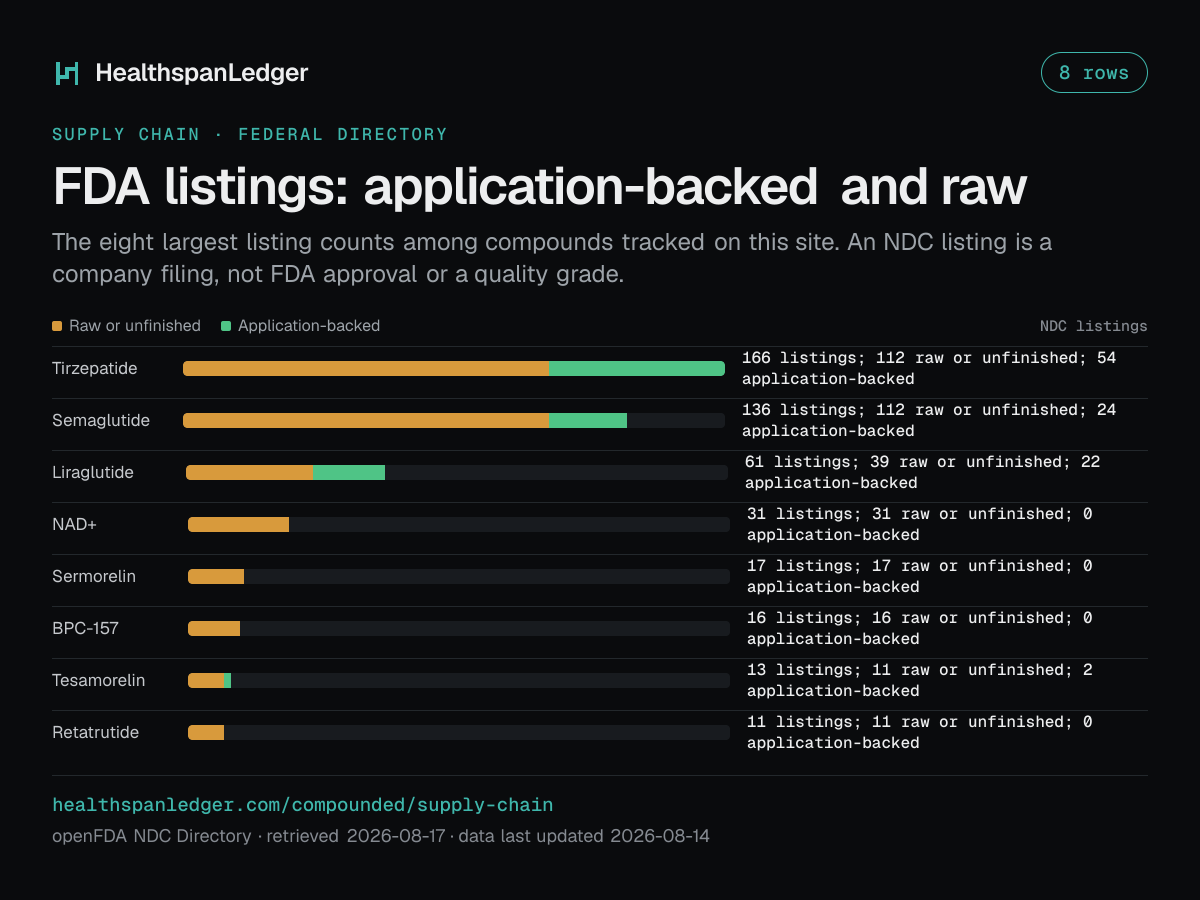
Most of what FDA lists is not medicine
Every row below is a package a company registered with FDA. Registering is a filing, not an approval: FDA publishes what it was told and does not check it. The split that matters is the last two columns — a finished, approved product against raw active ingredient.
| Compound | Listings | Approved product | Raw ingredient | Companies |
|---|---|---|---|---|
| Tirzepatide | 166 | 54 | 112 | 38 |
| Semaglutide | 136 | 24 | 112 | 49 |
| Liraglutide | 61 | 22 | 39 | 37 |
| NAD+ | 31 | 0 | 31 | 25 |
| Sermorelin | 17 | 0 | 17 | 16 |
| BPC-157 | 16 | 0 | 16 | 14 |
| Tesamorelin | 13 | 2 | 11 | 12 |
| Retatrutide | 11 | 0 | 11 | 6 |
| Ipamorelin | 10 | 0 | 10 | 10 |
| TB-500 | 10 | 0 | 10 | 8 |
| CJC-1295 | 9 | 0 | 9 | 9 |
| MOTS-c | 9 | 0 | 9 | 9 |
| PT-141 | 9 | 1 | 8 | 9 |
| Selank | 9 | 0 | 9 | 9 |
| Semax | 9 | 0 | 9 | 9 |
| Epitalon | 8 | 0 | 8 | 8 |
| Thymosin alpha-1 | 7 | 0 | 7 | 7 |
| GHK-Cu | 6 | 0 | 6 | 6 |
| SS-31 | 6 | 1 | 5 | 6 |
| DSIP | 5 | 0 | 5 | 5 |
| KPV | 5 | 0 | 5 | 5 |
| AOD-9604 | 4 | 0 | 4 | 4 |
| Melanotan II | 4 | 0 | 4 | 4 |
| Kisspeptin-10 | 3 | 0 | 3 | 3 |
| LL-37 | 3 | 0 | 3 | 3 |
| Cagrilintide | 2 | 0 | 2 | 2 |
| Hexarelin | 2 | 0 | 2 | 2 |
| IGF-1 LR3 | 2 | 0 | 2 | 2 |
| PEG-MGF | 2 | 0 | 2 | 2 |
| Pinealon | 2 | 0 | 2 | 2 |
The peptides are the clearest case. BPC-157, retatrutide, MOTS-c, epitalon, KPV and the rest have no approved product in the directory at all — every listing against them is a supplier registering the powder. Brenipatide, Eloralintide, Enicepatide, Macupatide, MariTide, Petrelintide, AHK-Cu, Mazdutide, Pemvidutide, Survodutide, VK2735, Zenagamtide has no listing of any kind, which is a fact about the registry rather than about the market.
Who registers the ingredient
These are the companies on the raw-ingredient listings, ordered by how many different compounds they register. Being here means a firm filed with FDA. It is not an approval, an inspection result or a recommendation, and nothing on this site links to any of them.
| Registrant | Compounds | Listings | Includes |
|---|---|---|---|
| Qingdao Biopeptek Co., Ltd. | 29 | 29 | AOD-9604, BPC-157, CJC-1295, Cagrilintide |
| DARMERICA, LLC | 25 | 26 | BPC-157, CJC-1295, Epitalon, GHK-Cu |
| El-Peptido (Shanghai) Biopharmaceutical Co., Ltd | 20 | 21 | AOD-9604, BPC-157, CJC-1295, DSIP |
| Shenzhen Alvantis Pharma Co., Ltd. | 19 | 21 | AOD-9604, BPC-157, CJC-1295, Cagrilintide |
| Pure Peptide Pharmaceuticals Inc. | 15 | 15 | AOD-9604, BPC-157, CJC-1295, DSIP |
| SCH Global Services Private Limited | 13 | 13 | BPC-157, CJC-1295, Epitalon, MOTS-c |
| APISTER LIFESCIENCES PRIVATE LIMITED | 9 | 9 | BPC-157, DSIP, MOTS-c, NAD+ |
| Hangzhou Pepsource Biomedical Co.,LTD | 7 | 7 | Epitalon, Ipamorelin, KPV, MOTS-c |
| Bills Biotech Pvt. Ltd. | 5 | 5 | Selank, Semaglutide, Semax, TB-500 |
| Hangzhou Pepsource Biomedical Co., LTD | 5 | 5 | BPC-157, CJC-1295, PT-141, Selank |
| Hybio Pharmaceutical Co., Ltd. (Pingshan Factory) | 4 | 21 | Liraglutide, Retatrutide, Semaglutide, Tirzepatide |
| Fujian Genohope Biotech Ltd. | 4 | 6 | Liraglutide, NAD+, Semaglutide, Tirzepatide |
| Huzhou Huida New Material Co., Ltd. | 4 | 4 | BPC-157, CJC-1295, Ipamorelin, Tesamorelin |
| Pharma Source Direct, Inc. | 4 | 4 | NAD+, Semaglutide, Sermorelin, Tirzepatide |
| Zhejiang Wild Wind Pharmaceutical Co.,Ltd. | 4 | 4 | BPC-157, Ipamorelin, Sermorelin, Tesamorelin |
What has been recalled, by compound
A recall covers named batches from one company. It is not a verdict on a substance, and a recall that FDA has closed was not a safe product — closing describes the paperwork. Sermorelin has been in FDA records the longest and has very few side-effect reports. Compare those records with the side-effect study.
308 distinct FDA recall events appeared across 318 tracked-search matches, including the glutathione class comparator. 10 events matched more than one tracked compound, so the downloadable table keeps one row per FDA recall number and lists every match on that row.
| Compound | Matched records | Companies | Most-used reason word |
|---|---|---|---|
| Sermorelin | 92 | 27 | sterility — 81 of 92 |
| Semaglutide | 54 | 17 | sterility — 27 of 54 |
| Tirzepatide | 21 | 6 | sterility — 12 of 21 |
| Ipamorelin | 18 | 8 | sterility — 18 of 18 |
| NAD+ | 16 | 9 | sterility — 11 of 16 |
| BPC-157 | 6 | 5 | sterility — 6 of 6 |
| CJC-1295 | 4 | 4 | sterility — 4 of 4 |
| Liraglutide | 4 | 2 | temperature — 3 of 4 |
| PT-141 | 4 | 4 | sterility — 4 of 4 |
| TB-500 | 4 | 3 | sterility — 4 of 4 |
| Melanotan II | 3 | 3 | sterility — 3 of 3 |
| AOD-9604 | 2 | 2 | sterility — 2 of 2 |
| Epitalon | 2 | 2 | sterility — 2 of 2 |
| GHK-Cu | 2 | 2 | sterility — 2 of 2 |
| IGF-1 LR3 | 2 | 1 | sterility — 2 of 2 |
| LL-37 | 2 | 2 | sterility — 2 of 2 |
| Tesamorelin | 2 | 2 | labeling — 1 of 2 |
| DSIP | 1 | 1 | sterility — 1 of 1 |
| Retatrutide | 1 | 1 | sterility — 1 of 1 |
23 of the compounds here have no recall record at all: AHK-Cu, Brenipatide, Cagrilintide, Eloralintide, Enicepatide, Hexarelin, Kisspeptin-10, KPV, Macupatide, MariTide, Mazdutide, MOTS-c, PEG-MGF, Pemvidutide, Petrelintide, Pinealon, Selank, Semax, SS-31, Survodutide, Thymosin alpha-1, VK2735, Zenagamtide. That is not a clean bill of health. A seller that never registered with FDA cannot recall anything, because it never entered the system that produces recalls.
For scale, glutathione — not a peptide, and a staple of injectable compounding — carries 78 recall records from 46 companies. Sterility failures are a property of making injections in small batches, not of peptides.
6Inspect the underlying records
Semaglutide recalls in detail
FDA has published 54 recall records naming semaglutide, filed by 17 companies, checked 21 September 2026.
| Hazard class | Records | What FDA means by it |
|---|---|---|
| Class II | 54 | Class II — FDA judged that using this product may cause temporary or medically reversible harm, and that serious harm is unlikely. |
| Ongoing | 47 | The recall is still running — the firm is still retrieving or correcting the product. |
| Completed | 3 | The firm has finished retrieving or correcting every unit it could reach. |
| Terminated | 4 | FDA has closed the recall. That is a statement about the process finishing, not about the product having been safe. |
FDA writes its own reason on each record. These are its words, counted:
- 27 of 54 recall records naming semaglutide use the word “sterility”.
- 13 of 54 recall records naming semaglutide use the word “particulate”.
- 3 of 54 recall records naming semaglutide use the word “temperature”.
- 2 of 54 recall records naming semaglutide use the word “endotoxin”.
FDA matched 1 of 54 recall records naming semaglutide to an approved product listing. The other 53 name a preparation with no approved product behind it.
These are counts of recall filings, not of problems per batch made. Many small pharmacies file many small recalls; one large manufacturer files few large ones. Nobody publishes how many units either side made, so these counts cannot be read as which is safer.
17 companies filed these recalls. This site does not name pharmacies or outsourcing facilities. FDA does, on the page behind each recall number, and the newest here is D-0747-2026.
Tirzepatide recalls in detail
FDA has published 21 recall records naming tirzepatide, filed by 6 companies, checked 21 September 2026.
| Hazard class | Records | What FDA means by it |
|---|---|---|
| Class I | 1 | Class I — FDA judged there is a reasonable probability that using this product will cause serious harm or death. |
| Class II | 20 | Class II — FDA judged that using this product may cause temporary or medically reversible harm, and that serious harm is unlikely. |
| Ongoing | 21 | The recall is still running — the firm is still retrieving or correcting the product. |
FDA writes its own reason on each record. These are its words, counted:
- 12 of 21 recall records naming tirzepatide use the word “sterility”.
- 1 of 21 recall records naming tirzepatide use the word “labeling”.
FDA matched 0 of 21 recall records naming tirzepatide to an approved product listing. The other 21 name a preparation with no approved product behind it.
These are counts of recall filings, not of problems per batch made. Many small pharmacies file many small recalls; one large manufacturer files few large ones. Nobody publishes how many units either side made, so these counts cannot be read as which is safer.
6 companies filed these recalls. This site does not name pharmacies or outsourcing facilities. FDA does, on the page behind each recall number, and the newest here is D-0394-2026.
Semaglutide listings in detail
FDA’s directory holds 136 semaglutide listings from 49 companies: 24 under an approved application and 112 registered as raw ingredient or an intermediate, checked 17 August 2026.
| Category | Listings | What it means |
|---|---|---|
| Approved drug (NDA) | 24 | An approved new drug application. FDA reviewed this product and approved it. |
| Bulk active ingredient | 55 | Raw active ingredient, registered by the establishment that supplies it. It is not a finished medicine and FDA has approved nothing here. |
| Bulk ingredient for compounding | 30 | Raw active ingredient registered for use in compounding. Registering the ingredient is not permission to compound it — that is a separate question with its own rules. |
| Intermediate for further processing | 27 | An intermediate shipped to another manufacturer for further processing. Not a finished medicine and not sold to patients. |
Who registers the raw ingredient, and what has been recalled, are on the compounded supply-chain record.
The concentrations these pens and vials actually hold
Every unit-conversion question depends on one number: milligrams per milliliter. FDA publishes it for each approved package, and these are its figures, with the NDC beside each one so you can look it up. A multi-dose Mounjaro vial holds 2.4 mL, so the same box covers four weekly doses.
| Product | FDA strength | Per mL | In the package | NDC |
|---|---|---|---|---|
| Mounjaro | 4.17 mg/mL | 4.17 mg/mL | 2.4 mL | 0002-4052 |
| Mounjaro KwikPen | 4.17 mg/mL | 4.17 mg/mL | 2.4 mL | 0002-3466 |
| Mounjaro | 2.5 mg/.5mL | 5 mg/mL | 0.5 mL | 0002-1152 |
| MOUNJARO | 2.5 mg/.5mL | 5 mg/mL | 0.5 mL | 50090-8025 |
| Mounjaro | 8.33 mg/mL | 8.33 mg/mL | 2.4 mL | 0002-4103 |
| Mounjaro KwikPen | 8.33 mg/mL | 8.33 mg/mL | 2.4 mL | 0002-3455 |
| Mounjaro | 5 mg/.5mL | 10 mg/mL | 0.5 mL | 0002-1243 |
| MOUNJARO | 5 mg/.5mL | 10 mg/mL | 0.5 mL | 50090-8024 |
| Mounjaro | 12.5 mg/mL | 12.5 mg/mL | 2.4 mL | 0002-4210 |
| Mounjaro KwikPen | 12.5 mg/mL | 12.5 mg/mL | 2.4 mL | 0002-3444 |
| Mounjaro | 7.5 mg/.5mL | 15 mg/mL | 0.5 mL | 0002-1484 |
| MOUNJARO | 7.5 mg/.5mL | 15 mg/mL | 0.5 mL | 50090-8023 |
| Mounjaro | 16.7 mg/mL | 16.7 mg/mL | 2.4 mL | 0002-4304 |
| Mounjaro KwikPen | 16.7 mg/mL | 16.7 mg/mL | 2.4 mL | 0002-3433 |
| Mounjaro | 10 mg/.5mL | 20 mg/mL | 0.5 mL | 0002-1471 |
| MOUNJARO | 10 mg/.5mL | 20 mg/mL | 0.5 mL | 50090-8021 |
| Mounjaro | 20.8 mg/mL | 20.8 mg/mL | 2.4 mL | 0002-4523 |
| Mounjaro KwikPen | 20.8 mg/mL | 20.8 mg/mL | 2.4 mL | 0002-3422 |
| Mounjaro | 12.5 mg/.5mL | 25 mg/mL | 0.5 mL | 0002-1460 |
| Mounjaro | 25 mg/mL | 25 mg/mL | 2.4 mL | 0002-4612 |
| MOUNJARO | 12.5 mg/.5mL | 25 mg/mL | 0.5 mL | 50090-8022 |
| Mounjaro KwikPen | 25 mg/mL | 25 mg/mL | 2.4 mL | 0002-3411 |
| Mounjaro | 15 mg/.5mL | 30 mg/mL | 0.5 mL | 0002-1457 |
| MOUNJARO | 15 mg/.5mL | 30 mg/mL | 0.5 mL | 50090-8026 |
| Zepbound | 4.17 mg/mL | 4.17 mg/mL | 2.4 mL | 0002-6052 |
| Zepbound KwikPen | 4.17 mg/mL | 4.17 mg/mL | 2.4 mL | 0002-3566 |
| Zepbound | 2.5 mg/.5mL | 5 mg/mL | 0.5 mL | 0002-0152 |
| ZEPBOUND | 2.5 mg/.5mL | 5 mg/mL | 0.5 mL | 0002-2506 |
| Zepbound | 8.33 mg/mL | 8.33 mg/mL | 2.4 mL | 0002-6103 |
| Zepbound KwikPen | 8.33 mg/mL | 8.33 mg/mL | 2.4 mL | 0002-3555 |
| Zepbound | 5 mg/.5mL | 10 mg/mL | 0.5 mL | 0002-0243 |
| ZEPBOUND | 5 mg/.5mL | 10 mg/mL | 0.5 mL | 0002-2495 |
| Zepbound | 12.5 mg/mL | 12.5 mg/mL | 2.4 mL | 0002-6210 |
| Zepbound KwikPen | 12.5 mg/mL | 12.5 mg/mL | 2.4 mL | 0002-3544 |
| Zepbound | 7.5 mg/.5mL | 15 mg/mL | 0.5 mL | 0002-1214 |
| ZEPBOUND | 7.5 mg/.5mL | 15 mg/mL | 0.5 mL | 0002-2484 |
| Zepbound | 16.7 mg/mL | 16.7 mg/mL | 2.4 mL | 0002-6304 |
| Zepbound KwikPen | 16.7 mg/mL | 16.7 mg/mL | 2.4 mL | 0002-3533 |
| Zepbound | 10 mg/.5mL | 20 mg/mL | 0.5 mL | 0002-1340 |
| ZEPBOUND | 10 mg/.5mL | 20 mg/mL | 0.5 mL | 0002-2471 |
| Zepbound | 20.8 mg/mL | 20.8 mg/mL | 2.4 mL | 0002-6523 |
| Zepbound KwikPen | 20.8 mg/mL | 20.8 mg/mL | 2.4 mL | 0002-3522 |
| Zepbound | 12.5 mg/.5mL | 25 mg/mL | 0.5 mL | 0002-1423 |
| Zepbound | 25 mg/mL | 25 mg/mL | 2.4 mL | 0002-6612 |
| ZEPBOUND | 12.5 mg/.5mL | 25 mg/mL | 0.5 mL | 0002-2460 |
| Zepbound KwikPen | 25 mg/mL | 25 mg/mL | 2.4 mL | 0002-3511 |
| Zepbound | 15 mg/.5mL | 30 mg/mL | 0.5 mL | 0002-2002 |
| ZEPBOUND | 15 mg/.5mL | 30 mg/mL | 0.5 mL | 0002-2457 |
These figures are what the reconstitution and unit calculators are checked against. The build fails if a package volume this site multiplies by stops appearing in FDA’s registry. It does not fail quietly and it does not correct itself: a person reads both sources and decides.
Where FDA’s registry disagrees with itself
One listing states two different volumes. The strength line and the packaging line do not match. We publish both rather than pick one.
- 0169-4517, WEGOVY: strength 1.7 mg/.75mL, packaging 0.5 mL.
What public records cannot tell you
Keep reading
- How compounded GLP-1 drugs are regulated — the 503A and 503B rules, and the shortage test.
- Compounded semaglutide, the FDA record — the determination, the deadlines and the dosing alert.
- Compounded tirzepatide, the FDA record — the determination FDA made, withdrew and made again.
- The dosing-error study — what people report after drawing a dose from a vial.
Questions people actually ask
Where does compounded semaglutide come from?
Does a listing in FDA’s directory mean FDA has approved it?
Have compounded GLP-1 drugs been recalled?
Why does BPC-157 have recalls but almost no side-effect reports?
Why are so many ingredient suppliers based outside the US?
Take the listing table
One row per listing, with the labeler, FDA’s marketing category and FDA’s own flag for whether the listing is a medicine or raw ingredient.
The tallies above are all recomputable from it. Nothing in the file was read off a server-side count.
How to cite this table
Analysis by HealthspanLedger · edition 2026.08 · version 378fefb14c5f · retrieved 2026-08-17
The underlying records are us government work, public domain and carry no copyright: the publisher’s own license. This table — how we select, join, label and bound the facts — is ours, and it is published under Creative Commons Attribution 4.0 International (CC BY 4.0). Reuse it, including commercially, and credit HealthspanLedger with a link to this page.
Take the recall table
One row per distinct FDA recall number, with every tracked search and compound match retained on that row. Hazard class and process status stay in separate columns, because they answer different questions.
A recall record is about a firm and a lot. It is not a verdict on a molecule.
How to cite this table
Analysis by HealthspanLedger · edition 2026.09 · version 5269b522fd7c · retrieved 2026-09-21
The underlying records are us government work, public domain and carry no copyright: the publisher’s own license. This table — how we select, join, label and bound the facts — is ours, and it is published under Creative Commons Attribution 4.0 International (CC BY 4.0). Reuse it, including commercially, and credit HealthspanLedger with a link to this page.
Sources
How we checked these details
Every count here is computed from a dated capture of FDA’s own data, committed to this repository and reviewable line by line. Each search expression is printed beside the figures it produced, so anyone can paste it into openFDA and get the same answer. No pharmacy, outsourcing facility or telehealth service is named, ranked or linked. Not legal advice, not a treatment recommendation. Corrections go to contact@healthspanledger.com.